Understanding FPV Drone Lenses: Key Optical Factors That Shape Flight Performance
Nov 28, 2025
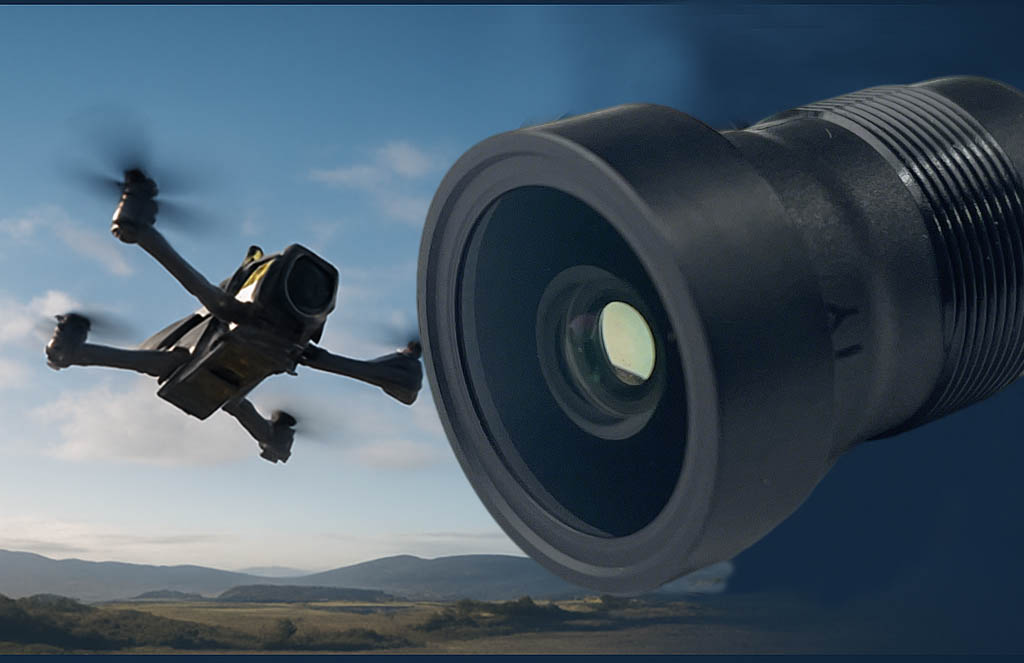
In FPV (First-Person View) drone systems, the lens plays a central role in determining image clarity, latency, field of view, and overall visual feedback during flight. As FPV drones continue to be used in freestyle flying, racing, cinematography, mapping, and training, understanding how an FPV lens is designed and what technical parameters matter can help users choose more suitable optical solutions for their application scenarios.
This article introduces the essential characteristics of an FPV drone lens, along with the optical design considerations that impact real-time flight perception.
1. Field of View (FOV): The Foundation of FPV Perception
The Field of View determines how much of the environment is visible in the camera feed.
For FPV flying, especially racing and freestyle, pilots typically prefer:
Ultra-wide FOV (150°–180° equivalent)
Allows better spatial awareness and smoother maneuvering
Wide-angle distortion control
Ensures the image remains recognizable and natural during fast movements
A well-designed ultra-wide angle lens balances wide coverage with acceptable distortion levels, providing pilots with stable visual cues.
2. Optical Resolution and Image Sharpness
Resolution affects how clearly the camera captures textures, positions, and details.
Key factors include:
Lens resolving power (MTF performance)
Optical distortion level
Chromatic aberration control
Sensor compatibility (1/1.8", 1/2", 1/3", etc.)
A high-resolution FPV drone lens should maintain consistent sharpness across the entire image, including the edges, as peripheral clarity is critical in wide-angle FPV feeds.
3. Latency Behavior and Optical Transmission Efficiency
Latency in FPV systems is influenced by both the camera and the optical lens.
Lens design affects latency indirectly through:
Light transmission efficiency (T-value)
Coating quality
Internal reflections and stray light control
A lens with high light transmission enables the sensor to obtain sufficient information more quickly, which supports low-latency FPV video transmission.
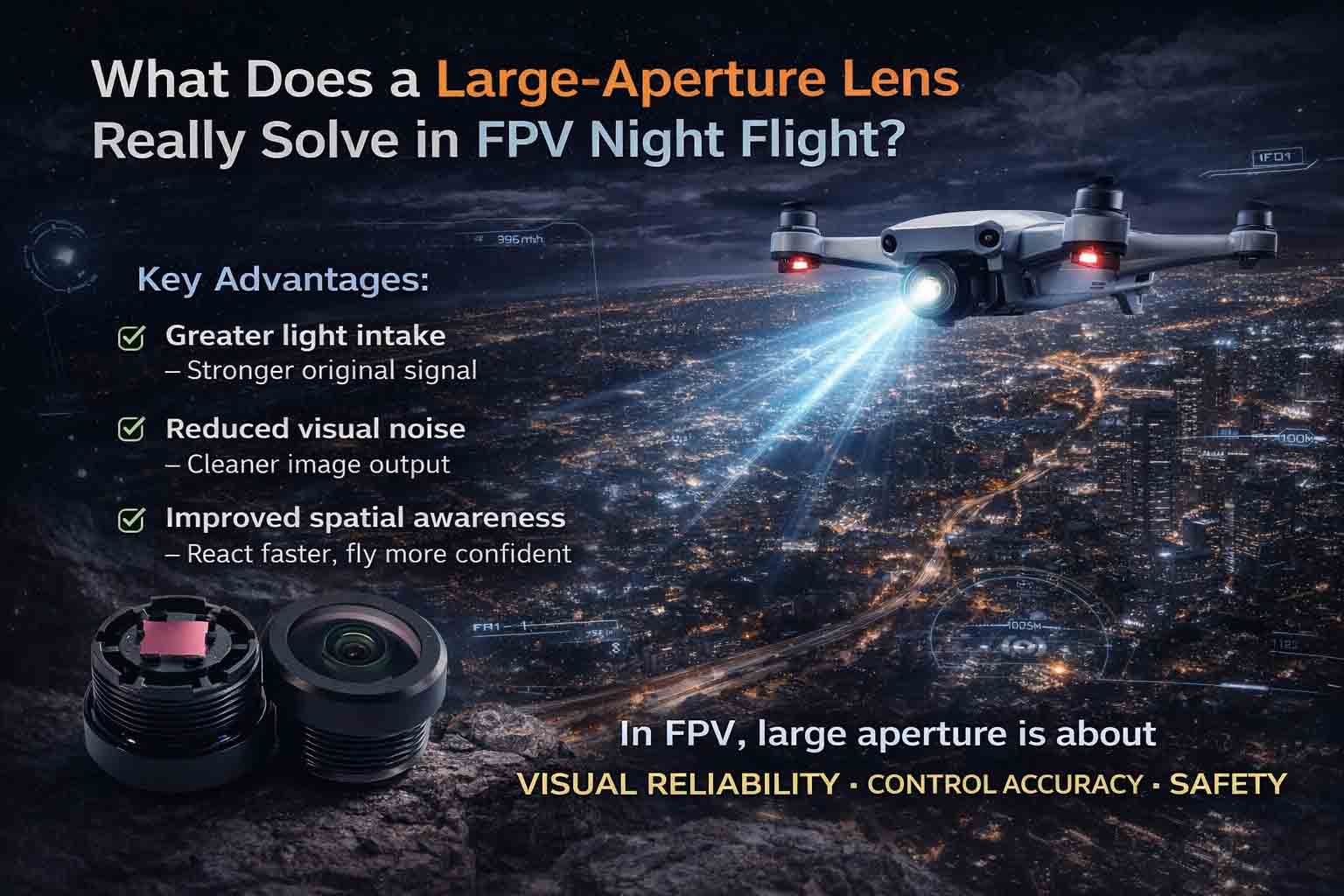
4. Aperture Size and Low-Light Performance
FPV flying often occurs in variable lighting conditions — indoor spaces, sunset environments, tunnels, or shaded outdoor areas.
A large aperture (e.g., F1.6 – F2.0) enables:
Improved low-light visibility
Reduced noise from the sensor
More stable exposure in fast transitions
Combined with appropriate anti-reflective coatings, a lens can maintain clear imaging in both bright and dim environments.
5. Lens Materials and Structural Durability
FPV drones experience vibration, rapid acceleration, and occasional impact. Thus, the physical structure of the lens is as important as its optical performance.
Considerations include:
Glass versus hybrid (glass + resin) elements
Lens barrel material (aluminum, PC/ABS, composite materials)
Resistance to temperature changes
Weight requirements for drone balance
A stable optical structure ensures consistent focus performance across repeated flights.
6. Sensor Compatibility and Image Format
Different FPV systems use different sensor sizes and aspect ratios.
Matching the lens to the sensor ensures:
Correct back focal distance
Optimal coverage without vignetting
Accurate focus position
Proper use of the sensor’s full dynamic range
Sensor formats commonly used in FPV include: 1/3", 1/2", 1/1.8" CMOS.
7. Application-Specific Lens Selection
Different FPV use cases require different optical priorities:
Freestyle FPV
Wide FOV
High image stability
Controlled distortion
FPV Racing
Extremely low latency
Fast light adaptation
Edge-to-edge clarity
Cinematic FPV
Higher resolution
Low-distortion imaging
Color rendering accuracy
Industrial FPV
High contrast
Consistent optical performance
Robust housing design




 Sign Up To Our Newsletters


 IPv6 network supported.