What Does a Large-Aperture Lens Really Solve in FPV Night Flight?
Jan 17, 2026
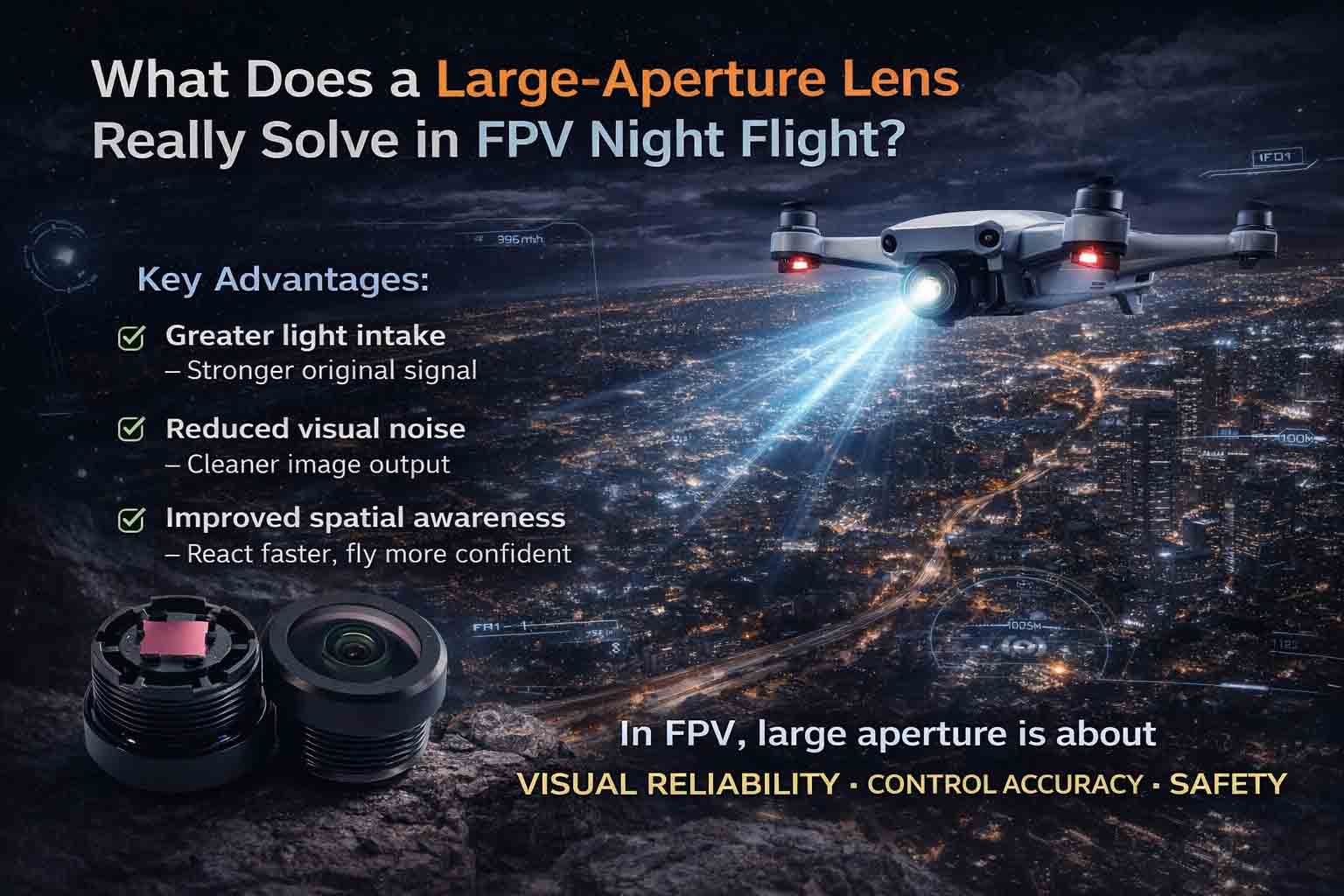
FPV drones are increasingly flown in low-light environments such as dusk, night scenes, or indoor spaces with limited illumination. In these conditions, image quality is not about aesthetics—it directly affects control accuracy and flight safety. One of the most discussed optical features in this context is the large-aperture lens.
But what does a large aperture really solve in FPV night flight?
Low-Light Challenges in FPV Flying
Unlike traditional aerial photography, FPV flying emphasizes real-time perception. Pilots rely on immediate visual feedback to judge speed, distance, and obstacles. In low-light conditions, FPV systems often face several challenges at the same time:
Insufficient ambient light
Increased image noise
Motion blur caused by fast maneuvers
Loss of detail in shadows and dark areas
These issues cannot be fully compensated by software alone. The quality of the optical input, starting with the lens, plays a critical role.
Why Large-Aperture Lenses Matter
A large-aperture lens allows more light to pass through the optical system and reach the image sensor. This increased light intake improves the original signal level before any image processing is applied.
Compared with smaller-aperture lenses, large-aperture FPV lenses help:
Preserve more detail in dark environments
Reduce excessive gain and noise amplification
Maintain clearer edges during fast motion
Improve overall image stability for real-time viewing
In FPV flight, these improvements translate directly into better situational awareness rather than visually pleasing images.
Optical Input Comes Before Image Processing
In many FPV systems, image signal processing (ISP) is used to enhance brightness and suppress noise. However, when the input signal is weak, aggressive ISP adjustments may introduce artifacts, latency, or loss of detail.
By using a lens with a larger aperture, the sensor receives a stronger and cleaner optical signal, reducing the need for heavy processing. This allows the FPV system to maintain a more natural and predictable image output—an important factor for pilots making split-second decisions.
Spatial Awareness and Control Accuracy
FPV pilots rely heavily on visual cues to judge depth, speed, and proximity to obstacles. In low-light conditions, insufficient light can flatten the image and obscure important details.
Large-aperture lenses help improve spatial awareness by:
Enhancing contrast in shadowed areas
Preserving depth cues during high-speed flight
Making obstacles and terrain changes easier to recognize
This improved perception supports faster reactions and more confident control, especially during night flying or indoor FPV practice.
Large Aperture Is Not About Cinematic Quality
It is important to note that in FPV applications, a large-aperture lens is not chosen for cinematic depth of field or artistic effects. Instead, it is selected for visual reliability.
FPV lenses are designed to prioritize:
Consistent brightness
Stable image geometry
Predictable visual feedback
In this context, large aperture is a practical engineering choice rather than a stylistic one.



 Sign Up To Our Newsletters


 IPv6 network supported.