Why Backup Cameras Get Blurry in High Heat — And How High-Performance Automotive Lenses Solve It
Jan 31, 2026
As vehicles become increasingly dependent on vision systems, the stability and clarity of automotive cameras have never been more important. Yet a common issue persists across the industry: backup cameras becoming blurry, hazy, or out of focus in high temperatures.
For OEMs and camera module manufacturers, understanding the root cause is essential — not only to improve system reliability but also to design products that can withstand real-world, extreme outdoor conditions.
Below, we break down the science behind heat-related image degradation and explain how advanced automotive camera lens technologies solve these challenges.
Why Backup Cameras Become Blurry in High Temperatures
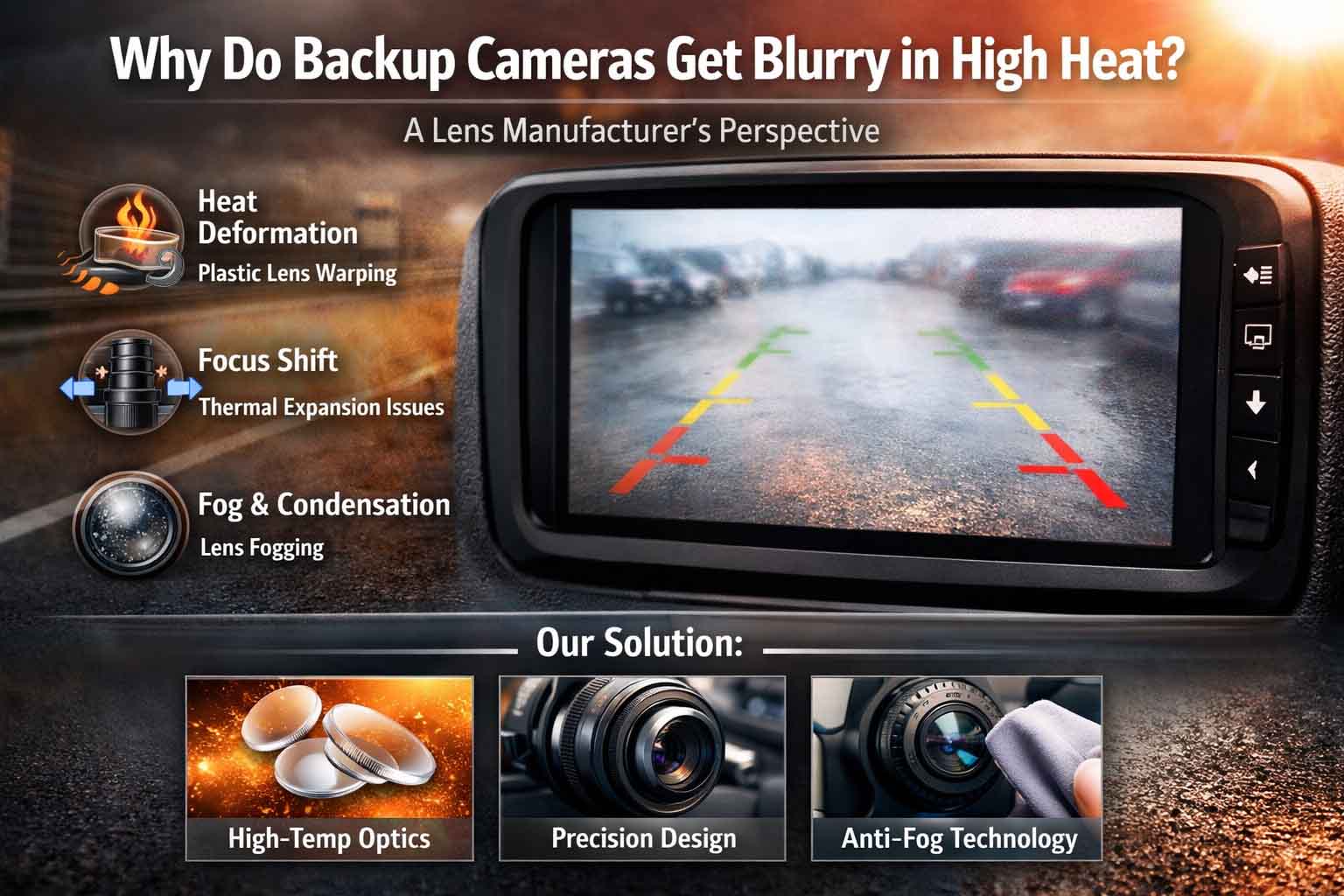
When temperatures rise — whether from strong sunlight, engine heat, or environmental exposure — the optical system inside the camera undergoes physical and chemical changes. The main causes include:
1. Heat Deformation of Optical Materials
Most entry-level automotive cameras use plastic lenses because they are lightweight and cost-effective. However, plastics have higher thermal expansion coefficients.
High heat can cause:
Micro-warping of the lens surface
Subtle changes in curvature
Image distortion and reduced sharpness
Even microns of deformation can shift the optical path, resulting in visible blur.
This is why selecting high-temperature-resistant optical lenses is critical for automotive applications.
2. Focus Shift Due to Thermal Expansion
Every component inside a camera — the barrel, the housing, the spacers, and the lens elements — expands at different rates in high heat. This creates mechanical stress and alters the spacing between optical elements.
The result?
The focal plane moves
Autofocus systems compensate poorly (or not at all, for fixed-focus cameras)
The image looks “soft” or slightly out of focus
This is one of the most common reasons for temperature-induced blur in backup camera lens systems.
3. Fogging and Internal Condensation
Rapid temperature changes or high humidity can cause microscopic condensation inside the lens assembly.
Fog buildup leads to:
Hazy, low-contrast images
Haloing around bright objects
A “washed-out” appearance
Cameras mounted near the bumper are especially vulnerable, as they’re exposed to rain, carwash cycles, and warm engine airflow.
To avoid this, manufacturers need better sealing, anti-fog coatings, and stable optical materials in their automotive lenses.
Why Traditional Lenses Are Not Enough
Conventional optics used in consumer electronics are not designed for:
70–90°C cabin or bumper temperatures
Direct sunlight exposure
High humidity environments
Continuous thermal cycles every day
Automotive environments demand a much higher standard. Clear imaging is not just about convenience — it is directly linked to driving safety.
This is where advanced automotive-grade camera lens technology makes the difference.
Our Engineering Approach: Lenses Designed for High-Heat Performance
As a specialized lens manufacturer, we focus on solving the exact problems that cause temperature-related blur. Our solutions include:
1. High-Temperature-Resistant Lens Materials
We use optical polymers and glass materials engineered for:
Low deformation
High thermal stability
Wide operating temperature ranges
This keeps the lens shape — and the image quality — stable even in intense heat.
2. Low-Thermal-Expansion Mechanical Design
Precision-engineered barrels and spacers ensure minimal dimensional change during temperature swings.
Benefits include:
Reduced focus shift
More consistent optical spacing
Long-term image reliability
This is essential for fixed-focus rear-view camera lenses.
3. Advanced Anti-Fog and Anti-Moisture Engineering
To prevent condensation and fogging, we incorporate:
Hydrophobic and anti-fog coatings
Improved internal sealing structures
Optimized ventilation paths (when appropriate)
These features maintain clarity in humid or rapidly changing environments.
Real-World Impact for Automotive Brands
Manufacturers who switch to high-stability automotive optics see improvements such as:
Fewer warranty claims
Fewer customer complaints about blurry images
Higher camera module reliability
Better performance in hot regions
Stronger competitiveness in ADAS and EV markets
In short: better optical design leads to better automotive safety.




 Sign Up To Our Newsletters


 IPv6 network supported.