High-Definition Automotive Backup Camera Lenses: Precision for Safer Reversing
Mar 06, 2025
In today’s automotive landscape, safety is no longer a luxury—it’s a necessity. As vehicles become smarter and drivers demand greater visibility, the role of high-definition automotive backup camera lenses has evolved from a convenience feature to a critical safety component. Whether navigating crowded parking lots, towing trailers, or reversing in low-light conditions, drivers rely on crisp, distortion-free imaging to avoid accidents. At the heart of these systems lies advanced optical technology, including M12 mount lenses, night vision lenses, and precision-engineered automotive lenses designed to perform under pressure.
The Rise of Backup Cameras: Why Optics Matter
Since their mandated inclusion in all new U.S. vehicles in 2018, backup cameras have prevented an estimated 17,000+ accidents annually (NHTSA). However, not all cameras are created equal. A system’s effectiveness hinges on one often-overlooked component: the automotive lens.
Key Challenges in Reversing Safety:
1.Blind Spots: Traditional rearview mirrors leave 30-50% of critical areas unseen.
2.Low-Light Conditions: 48% of parking accidents occur at night (IIHS).
3.Environmental Stress: Lenses must withstand temperature extremes, vibration, and moisture.
This is where specialized automotive backup camera lenses bridge the gap.
M12 Mount Lenses: The Compact Powerhouse
The M12 mount lens (also known as an S-mount lens) has emerged as the gold standard for automotive imaging systems. With a 12mm diameter thread, these lenses balance miniaturization with optical performance—a perfect fit for sleek, modern vehicle designs.
Why M12 Lenses Dominate Automotive Applications:
1.Space Efficiency: Their compact size integrates seamlessly into tight spaces like license plate housings or rearview mirrors.
2.Modular Compatibility: M12’s standardized threading allows quick swaps and upgrades.
3.Cost-Effective Scalability: Ideal for mass production without sacrificing quality.
For backup cameras, M12 lenses often pair with high-resolution sensors (2MP-8MP) to deliver 1920x1080p to 4K imaging. Combined with wide-angle designs (120°-170°), they eliminate blind spots while maintaining edge-to-edge sharpness.
Case Study: M12 Lens in Action
A leading European automaker reduced parking-related warranty claims by 22% after upgrading to M12-based systems with:
6G optical glass for scratch resistance
IR-cut filters to minimize color distortion
Aspherical surfaces correcting spherical aberrations
Night Vision Lenses: Seeing Beyond the Headlights
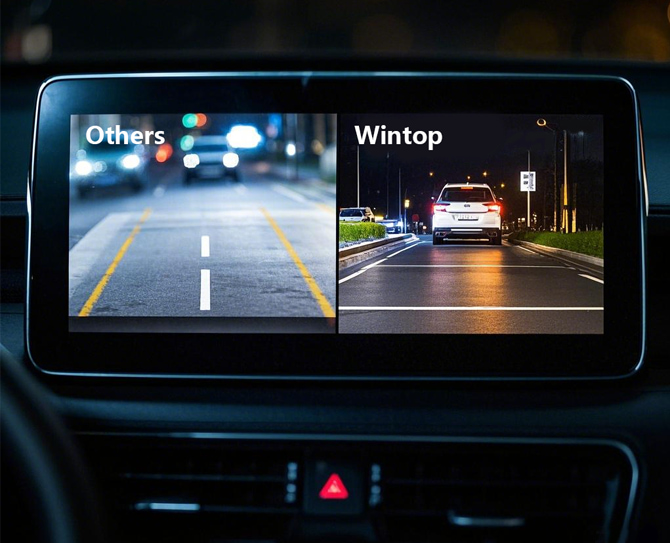
While daytime clarity is essential, night vision lens technology is where safety systems prove their worth. Over 75% of drivers report reduced confidence when reversing in darkness—a gap addressed by advanced low-light optics.
How Night Vision Lenses Work:
1.Wide Aperture (F1.4-F2.0): Maximizes light intake for brighter images.
2.Near-Infrared (NIR) Compatibility: Enhances visibility up to 30 meters in 0 lux conditions.
3.Anti-Glare Coatings: Reduces halos from streetlights or opposing headlights.
Recent innovations like starlight sensor technology push boundaries further, enabling color imaging in moonlight (0.001 lux).
Technical Breakdown: Night Vision vs. Standard Lenses
Feature
Standard Lens
Night Vision Lens
Aperture
F2.4
F1.6
Lux Range
1 lux+
0.001 lux
Coating
Single-layer AR
Multi-layer IR+AR
MTF @ 100 lp/mm
45%
65%
Engineering Reliability into Automotive Lenses
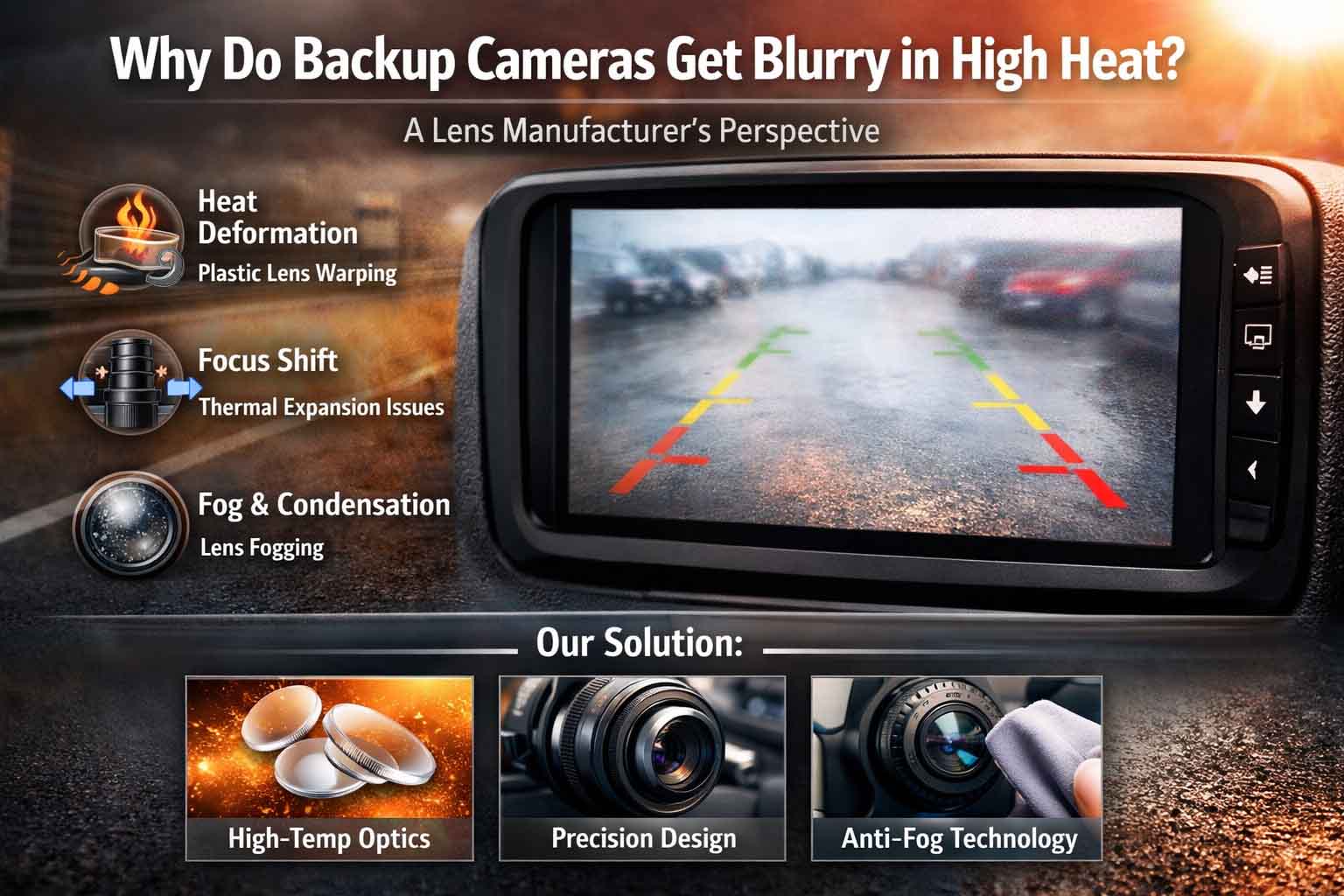
Automotive environments are unforgiving. From -40°C winters to 85°C engine heat, automotive lenses must perform flawlessly for decades.
Durability Benchmarks:
IP69K Rating: Resists high-pressure water jets and dust ingress.
20G Vibration Resistance: Survives potholes and off-road abuse.
UV-Stabilized Housing: Prevents yellowing from sun exposure.
Manufacturers like Wintop Optics achieve this through:
Automated Centering: Sub-3μm alignment precision for consistent focus.
Nano-Coating Technology: Water-repellent surfaces prevent fogging.
The Future of Reversing Safety: AI and Beyond
As vehicles transition toward autonomy, backup cameras are evolving into 360° surveillance systems. Emerging trends include:
1. AI-Powered Object Detection:
Lenses feed data to machine learning algorithms that identify pedestrians, cyclists, and obstacles in real time.
2. LiDAR Integration:
Hybrid systems combining M12 lenses with LiDAR enhance depth perception in fog or rain.
3. Cybersecurity:
Encrypted lens modules prevent hacking of video feeds—a growing concern for connected cars.
Choosing the Right Lens: A Buyer’s Checklist
Whether you’re an OEM engineer or an aftermarket installer, prioritize these features:
1.Resolution: Match lens MP to sensor capabilities (e.g., 8MP lens for 4K cameras).
2.Field of View (FoV): 150°+ for trucks/RVs, 120° for compact cars.
3.Iris Control: Auto-iris lenses adapt to sudden light changes (e.g., tunnel exits).
4.Certifications: ISO/TS 16949 compliance ensures automotive-grade reliability.
Wintop Optics: Your Partner in Optical Safety
With 15+ years of expertise, Wintop Optics delivers mission-critical automotive lenses trusted by global brands. Our solutions include:
M12 Mount Lenses: From 1.8mm fisheye to 12mm telephoto configurations.
Night Vision-Ready Optics: NIR coatings optimized for 850nm/940nm wavelengths.
Custom Engineering: Modify FoV, flange distance, or coatings for your platform.




 Sign Up To Our Newsletters


 IPv6 network supported.