What Is an M12 Lens? A Complete Guide to Compact Optical Solutions for Modern Vision Systems
Jul 04, 2026
What Is an M12 Lens?
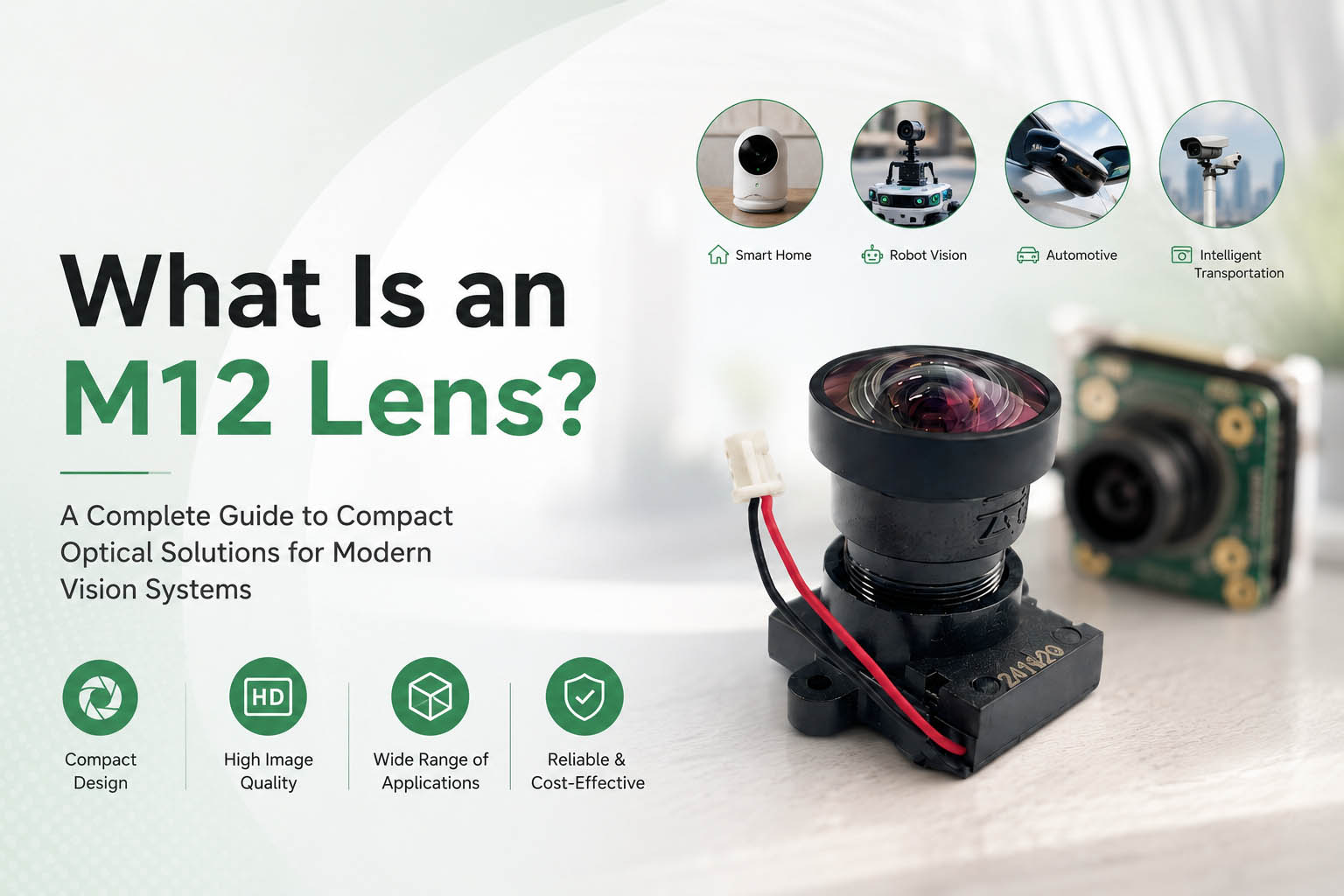
An M12 lens, also known as an S-Mount lens, is a compact optical lens that features a standard M12 × 0.5 threaded mount. Thanks to its lightweight design, small size, and cost-effective integration, the M12 lens has become one of the most widely used optical components in modern embedded vision systems.
Unlike traditional C-mount or CS-mount lenses, M12 lenses are designed for compact cameras and embedded devices where space is limited. They are commonly paired with CMOS image sensors and are available in a wide range of focal lengths, fields of view, and aperture options to meet different imaging requirements.
Today, M12 lenses are widely used in applications such as robot vision, smart home cameras, automotive cameras, baby monitors, smart doorbells, drones, industrial automation, and intelligent transportation systems.
Why Are M12 Lenses So Popular?
The popularity of the M12 camera lens comes from its excellent balance between optical performance, compact size, and design flexibility.
Compared with larger industrial lenses, M12 lenses offer several important advantages:
Compact and lightweight design for embedded cameras
Wide selection of focal lengths from ultra-wide-angle to telephoto
Compatibility with various CMOS sensors
Cost-effective solution for mass production
Easy integration into compact electronic devices
Available with low-distortion and large-aperture optical designs
As AI vision technology continues to expand, manufacturers increasingly choose M12 camera lenses for applications that require reliable image quality without increasing product size.
Common Applications of M12 Camera Lenses
Thanks to their versatility, M12 camera lenses are used across many intelligent vision systems.
Smart Home
Baby monitor cameras
Smart doorbells
Indoor security cameras
Pet monitoring cameras
Robotics & Automation
Robot vision lens solutions
AMR and AGV navigation
Binocular recognition systems
Pick-and-place robotic arms
Machine vision guidance
Automotive
ADAS cameras
Surround-view systems
Driver monitoring systems
Rear-view cameras
Intelligent Transportation
License plate recognition (LPR)
Traffic monitoring
Smart parking systems
Consumer Electronics
AI cameras
Drones
Smart devices
Video conferencing equipment
Choosing the correct robot vision lens is especially important for robotic systems because image quality directly affects positioning accuracy, object recognition, and navigation performance.
How to Choose the Right M12 Lens
Selecting the ideal M12 lens depends on the specific application rather than simply choosing the highest resolution.
Key factors to evaluate include:
Sensor compatibility
Focal length
Field of View (FOV)
Aperture (F-number)
TV distortion
Working distance
Relative illumination
Mechanical dimensions
Environmental requirements
For example, a baby monitor typically benefits from a wide-angle lens with a large aperture to provide broad coverage and reliable low-light imaging, while a robot vision lens often prioritizes low distortion and accurate optical performance for precise positioning.
Working with an experienced optical manufacturer can significantly reduce development time and ensure the lens is optimized for your camera module and application.
Why Choose Wintop Optics?
At Wintop Optics, we specialize in designing and manufacturing high-quality M12 lenses for a wide range of intelligent vision applications. From smart home products and automotive cameras to robotics and industrial automation, our engineering team develops customized optical solutions that meet the unique requirements of each project.
Beyond our product portfolio, Wintop Optics provides comprehensive support throughout the development process, including optical design consultation, rapid prototype development, camera module matching, performance optimization, and reliable mass production. Our experienced engineering team works closely with customers to shorten development cycles while maintaining consistent quality and dependable delivery.
Whether you need a standard M12 camera lens or a fully customized robot vision lens, Wintop Optics is committed to helping you build smarter, more reliable vision systems.
Contact Wintop Optics today to discuss your next optical project and discover how our customized lens solutions can bring your vision products to life.
FAQ
1. What is an M12 lens used for?
An M12 lens is widely used in embedded cameras, smart home devices, robot vision systems, automotive cameras, drones, industrial automation, and intelligent transportation applications.
2. What is the difference between an M12 lens and a C-mount lens?
An M12 lens uses an M12 × 0.5 threaded mount and is much smaller than a C-mount lens. M12 lenses are ideal for compact embedded devices, while C-mount lenses are typically used in high-end industrial machine vision systems.
3. Can an M12 lens be used for robot vision?
Yes. Many robot vision lens solutions are based on the M12 mount because of their compact size, wide-angle options, and compatibility with embedded vision cameras used in robots, AMRs, and robotic arms.
4. How do I choose the right M12 camera lens?
Consider your sensor size, focal length, field of view, working distance, aperture, distortion requirements, and lighting conditions. Working with an experienced optical manufacturer can help ensure the lens matches your specific application.
5. Does Wintop Optics provide customized M12 lens solutions?
Yes. Wintop Optics offers customized M12 lens design, optical optimization, prototype support, camera module integration, and mass production services for applications including smart home, robotics, automotive, AI vision, and industrial imaging.




 Sign Up To Our Newsletters


 IPv6 network supported.