other
  • Are the optical properties of the Drone lens anti-glare?
    Are the optical properties of the Drone lens anti-glare? Jul 02, 2024
    The optical performance of a drone lens can be anti-glare, but this depends on the lens design and material selection. Anti-glare means that the uav lens can reduce or eliminate the reflection and scattering of light when facing a strong light source, maintaining the clarity and contrast of the image. Here are some common anti-glare technologies and features: Coating technology: By applying a special optical coating to the surface of the uav lens, the reflection and scattering of the high resolution lens can be reduced. Common optical coating technologies include anti-reflective coating (AR coating), reflective coating and anti-reflection coating, etc. These coating layers can improve the light transmittance and anti-glare performance of the lens to a certain extent. Lens design: The design of the lens can consider increasing the light transmission aperture ratio, reducing the thickness of the glass material and defocusing power, etc., thereby reducing the reflection and scattering of light. Excellent lens design can effectively reduce glare and improve the anti-glare ability of the lens. Lens hood and filter: A hood can be added to the design of the Drone lens to shield the light from the side or backlight and reduce the reflection and scattering of the light. Additionally, using filters can help reduce certain wavelengths of light. It should be noted that although the Drone lens can have a certain anti-glare ability, glare may still occur when facing extremely strong light sources such as direct sunlight, lasers, etc. Therefore, when using a drone, users still need to be careful not to point the drone lens directly at a strong light source to avoid affecting vision, and pay attention to light changes in the environment, and adjust the shooting angle and posture in a timely manner to obtain clear and low glare Image.  
  • How Drone Camera Lenses Capture Clear Images from the Sky
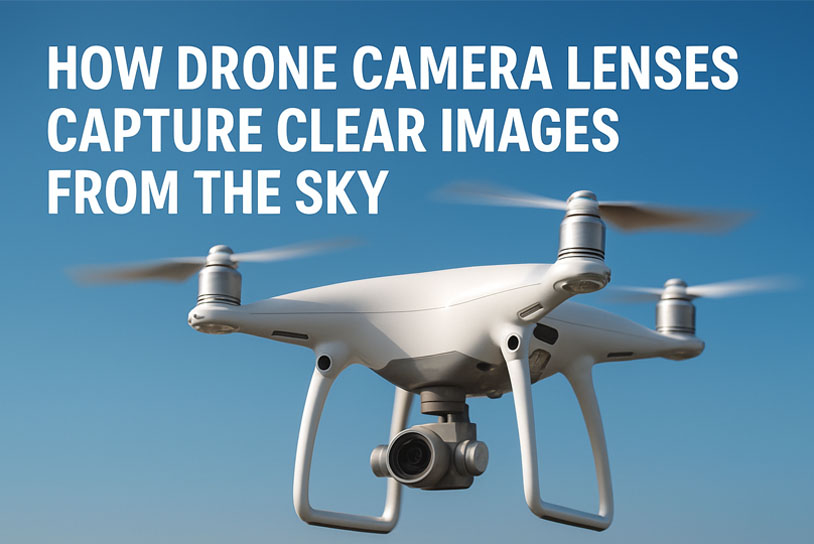
    How Drone Camera Lenses Capture Clear Images from the Sky Aug 21, 2025
    一、Introduction: The Eyes of a Drone In modern aerial photography and surveillance, the drone camera lens plays the same role as the human eye. While many people focus on the drone’s flight stability or battery life, the lens is the real key to capturing sharp, distortion-free, and high-contrast images from the sky. Choosing the right UAV lens directly determines image quality, performance in low light, and the ability to support advanced functions such as night vision and real-time monitoring. 二、Why Drone Camera Lenses Matter Unlike traditional cameras, aerial imaging faces unique challenges: vibrations during flight, changes in light conditions, and the need for wide-angle views without distortion. A professional drone lens must be: Lightweight and compact to minimize the impact on drone flight time. High-resolution to ensure every detail is captured from hundreds of meters above the ground. Low distortion to maintain accurate perspective, especially important for mapping and surveillance. 三、Key Features of Professional UAV Lenses Wide Field of View (FOV) – Helps drones cover more area in fewer passes. Low-Light and Night Vision Capability – Essential for night surveillance, search and rescue, and security monitoring. Durability – Lenses must withstand temperature changes, humidity, and even vibrations during long flights. Compatibility – Matching the lens with different image sensors (e.g., 1/2.8", 1/2.3") ensures optimal performance. By addressing these factors, a drone camera lens ensures stable and reliable imaging in various aerial scenarios. 四、Applications of Drone Camera Lenses Aerial Mapping & Surveying: High-resolution lenses deliver precise data for land planning and agriculture. Security & Surveillance: Wide-angle lenses provide a broader coverage for monitoring. Search & Rescue Operations: Night vision lenses enhance visibility in low-light or no-light conditions. Cinematic Aerial Photography: Lenses with low distortion and high contrast ensure stunning visual results. 五、Wintop Optics Drone Lens Solutions At Wintop Optics, we design and manufacture professional drone lenses tailored for aerial applications. Our product portfolio includes: Lightweight wide-angle UAV lenses for long endurance flights. Infrared and night vision lenses for enhanced low-light performance. Custom solutions for drone manufacturers who require unique specifications. With over 19 years of optical expertise, Wintop ensures every drone camera lens meets strict quality standards for clarity, stability, and durability. 六、Elevating Aerial Imaging The next time you see a drone capturing breathtaking landscapes or performing a rescue mission at night, remember that the lens is the hidden hero behind the scenes. Choosing the right UAV lens not only improves image quality but also expands the drone’s capabilities across industries. Explore our full range of drone and UAV lenses to find the right solution for your application.
  • How Obstacle Avoidance Lenses Support Safer Drone Navigation
    How Obstacle Avoidance Lenses Support Safer Drone Navigation Jan 09, 2026
    As drones are increasingly used in industrial inspection, logistics, mapping, and autonomous navigation, obstacle avoidance systems have become a critical part of UAV design. Among the many components involved, the camera lens plays a fundamental role in how reliably a drone can perceive its surroundings. This article focuses on the role of ultra-wide-angle lenses in drone obstacle avoidance systems and explains how optical design influences detection performance in real-world flight scenarios. The Role of Vision in Drone Obstacle Avoidance Most vision-based obstacle avoidance systems rely on cameras to detect nearby objects, estimate distance, and support path planning. Unlike aerial imaging or photography, obstacle avoidance focuses on short-range perception, requiring the camera to capture as much of the surrounding environment as possible. For this reason, obstacle avoidance cameras typically use ultra-wide-angle lenses, which provide a broader field of view compared to standard lenses. A wider field of view helps reduce blind spots and allows the system to detect obstacles earlier, especially during low-altitude or indoor flight. Why Ultra-Wide Field of View Matters An obstacle avoidance lens must balance coverage and accuracy. Lenses with an ultra-wide field of view can capture a larger scene within a single frame, making them well-suited for detecting nearby structures such as walls, trees, cables, or building edges. However, extreme wide-angle optics also introduce challenges such as distortion and edge image degradation. For drone navigation, controlled distortion and stable edge performance are essential, as inaccurate geometry may affect spatial judgment and obstacle localization. Optical Design Considerations for Obstacle Avoidance Lenses When selecting a lens for drone obstacle avoidance, engineers typically consider several optical parameters: Field of View (FOV): A wide horizontal and diagonal FOV improves environmental awareness. Distortion Control: Lower distortion supports more accurate distance estimation and object positioning. Compact Structure: Lightweight and short total track length (TTL) help reduce payload weight. Image Stability: Consistent image quality across the frame supports reliable vision algorithms. Environmental Protection: Outdoor drones often require lenses with dust and moisture resistance. Lenses such as the YT-6047P-C1, designed with ultra-wide-angle optics and compact mechanical structure, aim to meet these requirements for close-range drone vision systems. Sensor Compatibility and System Integration Obstacle avoidance lenses are typically paired with CMOS image sensors used in automotive or industrial vision systems. Sensors such as SC120AT, commonly applied in vehicle vision applications, offer stable image output and reliability, making them suitable for certain UAV vision systems as well. While these sensors are not exclusively designed for drones, their performance characteristics allow them to be integrated into industrial or autonomous UAV platforms, especially where robustness and consistent output are prioritized. Application Scenarios Ultra-wide-angle obstacle avoidance lenses are commonly used in: Forward or downward obstacle detection cameras Indoor or low-altitude autonomous flight Industrial drones operating in structured environments Navigation assistance for autonomous or semi-autonomous UAVs In these scenarios, the lens does not aim to produce cinematic images, but rather to provide predictable and reliable visual input for perception algorithms.

Need Help? Chat with us

Leave a message
For any request of information or technical support, fill in the form. All fields marked with an asterisk* are required.
Submit

Home

Products

whatsApp

contact