Large Aperture Drone Lenses: A Key Factor in High-Quality Aerial Imaging
Dec 20, 2025
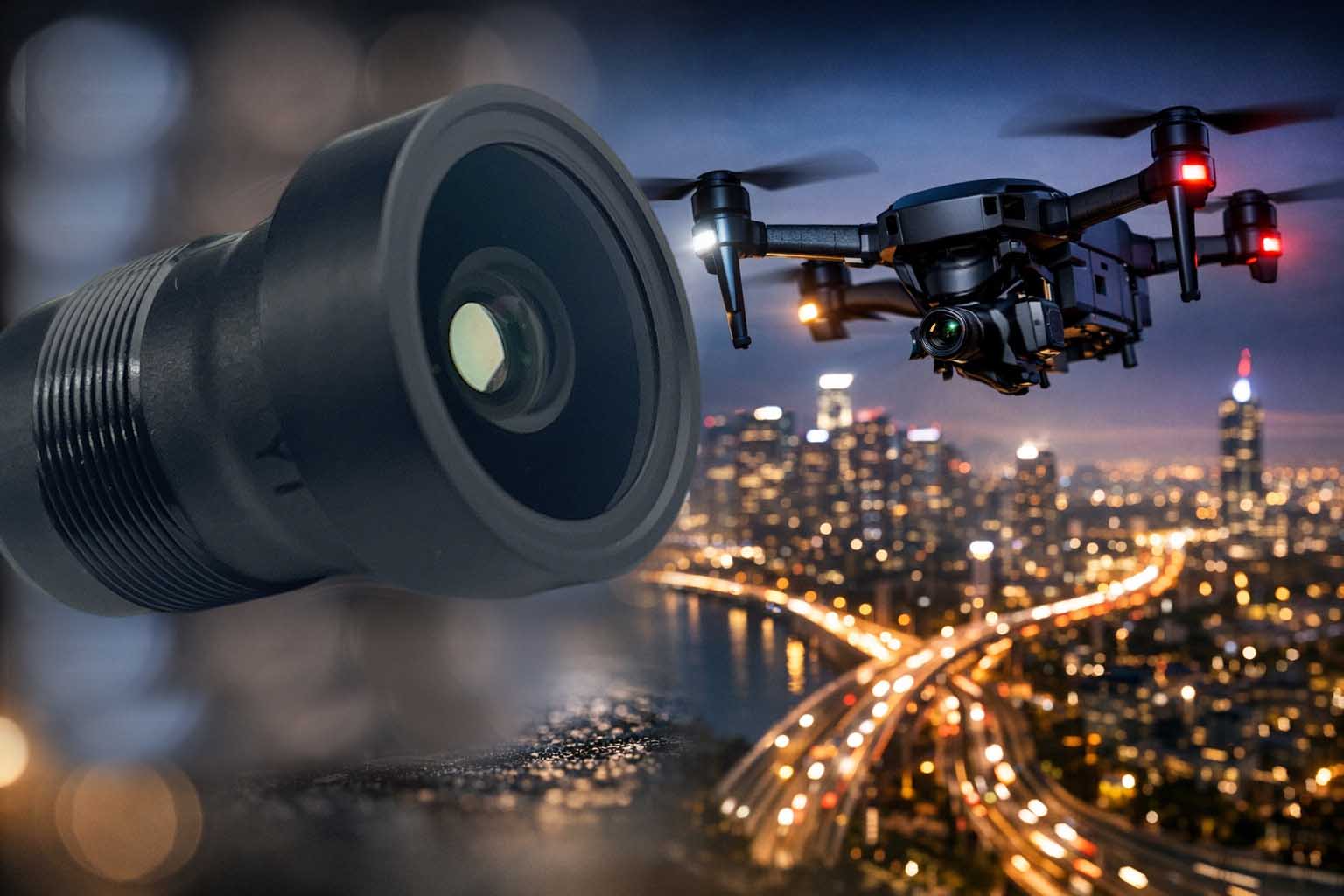
As drones continue to expand their role in aerial photography, inspection, mapping, and security applications, image quality has become a critical performance indicator. Among the many optical components, the large aperture drone lens plays an increasingly important role in improving aerial imaging performance, especially in challenging lighting conditions.
What Is a Large Aperture Drone Lens?
In optical systems, aperture size is expressed by the F-number. A smaller F-number indicates a larger aperture. A large aperture drone lens typically refers to lenses with apertures such as F1.1, F1.2, or F1.4, which allow significantly more light to reach the image sensor compared to standard drone camera lenses.
This increased light intake is particularly beneficial for drones operating in low-light or high-speed flight environments.
Advantages of Large Aperture Lenses in Drone Applications
1. Better Low-Light Performance Drones are often deployed during dusk, nighttime, or in environments with uneven lighting. A large aperture drone lens improves light-gathering capability, enabling clearer images with reduced noise and better detail retention in low-light aerial imaging.
2. Faster Shutter Speeds for Dynamic Scenes During high-speed flight or in windy conditions, motion blur can easily degrade image quality. With a large aperture, drone cameras can maintain faster shutter speeds without underexposure, resulting in sharper and more stable aerial footage.
3. Improved Signal-to-Noise Ratio When paired with high-resolution image sensors, a large aperture drone camera lens helps improve the overall signal-to-noise ratio. This leads to smoother tonal transitions, improved contrast, and more accurate color reproduction.
Optical Design Challenges of Large Aperture Drone Lenses
While large apertures offer clear imaging advantages, they also introduce greater optical design complexity. High-performance drone camera lenses must balance image quality, size, and weight through precise engineering, including:
Advanced multi-element optical designs to control distortion and aberrations
High-transmittance optical coatings to reduce flare and ghosting
Lightweight mechanical structures suitable for drone payload limits
Optimized compatibility with high-pixel CMOS sensors
As a result, large aperture drone lenses are most commonly used in professional and industrial drone systems.
Expanding Application Scenarios
Today, large aperture drone lenses are widely used in night patrol drones, emergency response drones, security surveillance platforms, and cinematic aerial drones. In these scenarios, reliable image quality under complex lighting conditions is essential for mission success.



 Sign Up To Our Newsletters


 IPv6 network supported.