What Are You Looking For?

Why Embodied AI Needs Ultra-Wide Vision Systems
May 22, 2026Embodied AI is transforming the way robots interact with the physical world. Unlike traditional artificial intelligence systems that process data in virtual environments, embodied AI relies on real-world perception, decision-making, and physical actions. From humanoid robots and autonomous mobile robots (AMRs) to service robots and warehouse automation systems, these intelligent machines must continuously observe and understand their surroundings. To achieve this, developers require high-quality visual data and advanced sensing hardware. This growing demand has made ultra-wide angle camera lenses for embodied AI an essential component in modern robotic vision systems.
When collecting visual data for robot learning, conventional lenses often suffer from limited fields of view, resulting in blind spots and incomplete environmental information. During first-person data collection for robot training, robots must capture objects, obstacles, human interactions, and surrounding environments simultaneously. A narrow viewing angle may miss critical details that affect navigation and task execution. By integrating a fisheye lens for robot vision systems, developers can significantly expand coverage, reduce blind areas, and improve the quality of training datasets. A wider perspective enables robots to better understand spatial relationships and environmental context, which are crucial for autonomous decision-making.
The rapid development of embodied AI has created strong demand for large-scale visual datasets. Many AI companies now use wearable data collection devices, teleoperation platforms, and first-person recording systems to gather real-world training data. In these applications, an ultra-wide angle lens for AI data collection devices can capture more information within a single frame, improving data efficiency while reducing the number of cameras required. Whether recording human demonstrations, warehouse operations, retail interactions, or industrial workflows, wide-angle imaging helps preserve contextual information that supports advanced robot learning algorithms. This makes fisheye camera lenses for embodied AI training increasingly valuable in next-generation robotics projects.
Environmental awareness is one of the most important capabilities for intelligent robots. To safely navigate dynamic environments, robots must accurately detect people, objects, pathways, and unexpected obstacles. An ultra-wide field-of-view lens for autonomous robots provides comprehensive scene coverage that improves perception accuracy and situational awareness. Combined with AI vision algorithms, fisheye imaging can support object detection, SLAM mapping, obstacle avoidance, and behavioral learning. As robots move into more complex real-world applications, from logistics and smart manufacturing to household assistance, wide-angle visual perception becomes a key competitive advantage.
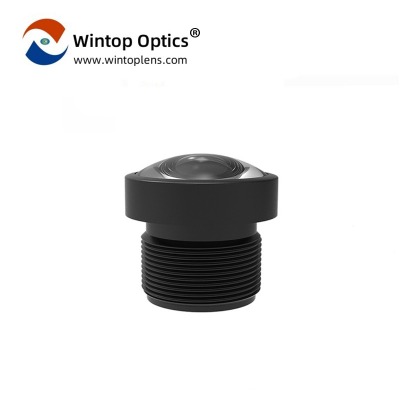
At WINTOP OPTICS, we specialize in developing high-performance fisheye and ultra-wide-angle lens solutions for emerging AI vision applications. Our lenses are designed to deliver expansive fields of view, excellent image quality, and reliable performance for embodied AI data collection systems, humanoid robot vision platforms, and wearable first-person recording devices. Beyond advanced optical design, WINTOP provides flexible customization services, rapid project support, low MOQ options, strict quality control, and extensive experience serving global customers in robotics, automotive, security, and intelligent imaging industries. With strong R&D capabilities and years of optical innovation, WINTOP helps customers accelerate product development and build more capable robotic vision systems for the future.
Looking for a fisheye lens solution for your embodied AI project? Contact WINTOP OPTICS today and discover how ultra-wide vision can power the next generation of intelligent robots.
 Sign Up To Our Newsletters
Tel : Overseas contact Lina : 86 153-0268-9906
Overseas emial : yorty@yuntal.com
WhatsApp : +86 153-0268-9906
E1108, Jinbolong Building, Longhua, Shenzhen,Guangdong, China


Friendly Links :
whatsappCopyright © 2026 WINTOP OPTICS. All Rights Reserved.粤ICP备2025439823号-1
 IPv6 network supported.