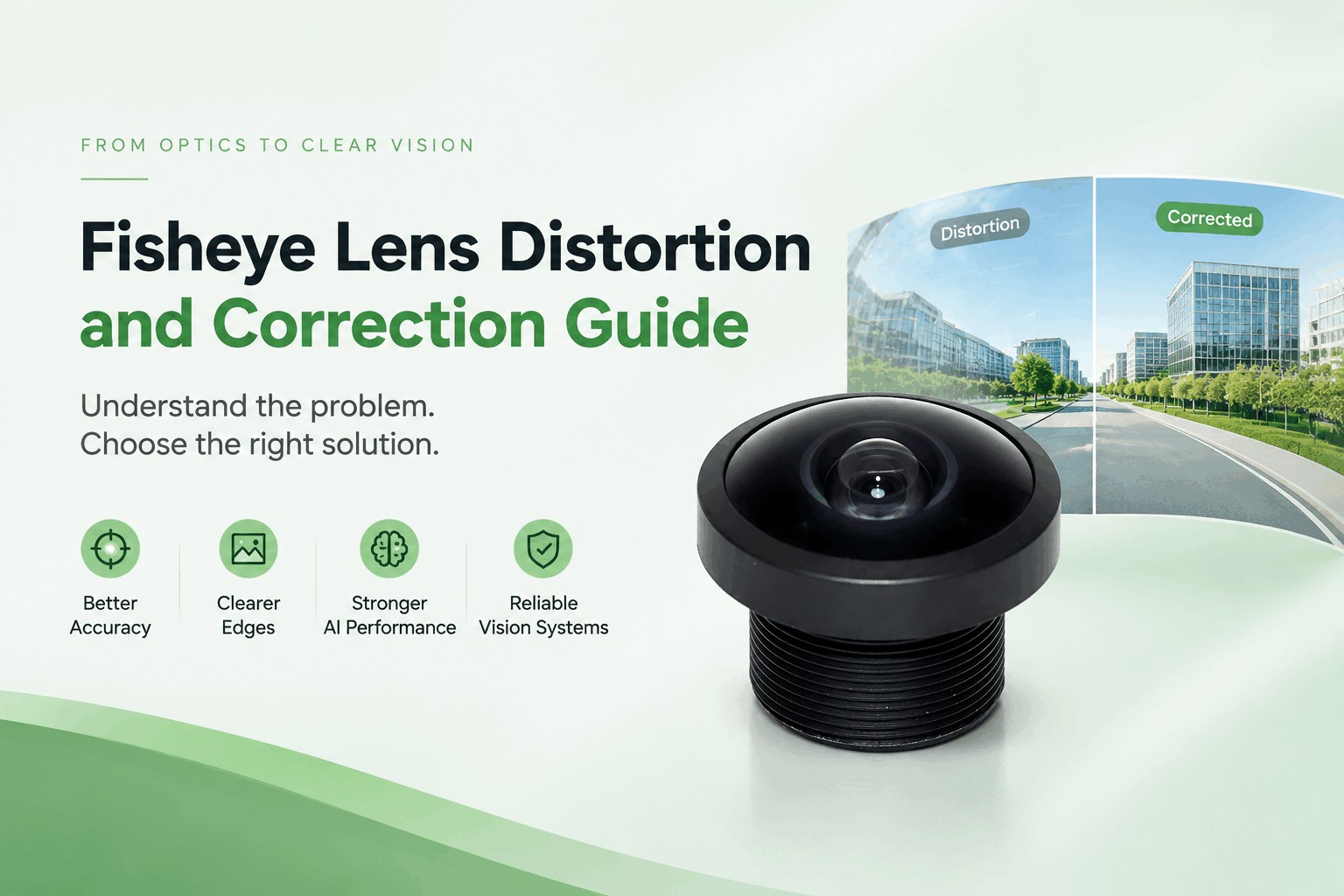
Fisheye Lens Distortion in Machine Vision: Optical vs. Software Correction Guide
Oct 15, 2026
Fisheye lenses deliver ultra-wide fields of view (FOV) from 160° to 200°, making them vital for AMR/AGV SLAM navigation, ADAS surround-view (AVM), and embedded machine vision systems.
However, this wide-angle capability comes with a core tradeoff: uncontrolled fisheye distortion. Uncontrolled distortion causes positioning errors, image stitching artifacts, unreliable object detection, and poor AI model performance.
While many engineers rely purely on software dewarping, software cannot recover optical information already lost at the CMOS sensor. The most reliable vision systems combine optical distortion control at the lens design stage with calibrated software fine-tuning. This guide breaks down fisheye distortion, its real-world impacts, and practical optical correction strategies.
What Is Fisheye Lens Distortion? A Complete Overview
Fisheye distortion is inherent radial barrel distortion, not a manufacturing defect.
Rectilinear lenses keep straight lines straight across the whole image.
Fisheye lenses use equidistant projection to fit a hemispherical scene onto a flat sensor. Image magnification drops toward the frame edges, causing real-world straight lines to curve outward. Objects near borders look compressed with fewer pixels.
Two primary distortion types affect machine vision:
Radial barrel distortion (dominant): The main source of geometric errors for SLAM, image stitching and measurement tasks.
Tangential distortion: Caused by minor lens element misalignment or sensor tilt. Less noticeable on well-made lenses, yet critical for high-precision stereo and binocular robot vision.
How Fisheye Distortion Hurts Machine Vision Performance
Distortion skews scene geometry, directly degrading computer vision algorithms across key industrial and automotive applications:
Impact on AMR & AGV SLAM Navigation
Distorted images skew feature point extraction. Compressed objects at image borders lower obstacle detection confidence, causing geometric errors to accumulate frame-by-frame and reducing localization accuracy.
Impact on Automotive AVM Surround-View Systems
Severe barrel distortion leads to stitching misalignment and deformed curb or obstacle outlines. Heavy software remapping blurs edge details and increases ECU processing latency.
Impact on Binocular Robotic Stereo Vision
When selecting a 3D robotic vision lens setup, mismatched distortion parameters between paired fisheye lenses introduce systematic depth calculation errors, severely reducing precision in pick-and-place and 3D inspection tasks.
Impact on AI Object Detection & Neural Networks
Convolutional neural networks (CNNs) trained on standard rectilinear datasets perform poorly on distorted fisheye inputs. Retraining AI models with distorted datasets adds significant development time and cost.
Optical Correction Techniques & Recommended Workflow
Optical correction suppresses native barrel distortion during the lens design phase before the image reaches the sensor. Key optical techniques include:
Aspherical Lens Elements: Used to counter barrel distortion while maximizing edge sharpness.
Multi-Element Optical Groups: Designed to balance optical aberrations across the entire FOV.
Chief Ray Angle (CRA) Matching: Aligning lens CRA with the target CMOS sensor to prevent pixel crosstalk and edge vignetting.
Tight Assembly Tolerances: Minimizing tangential decentering distortion during mass production.
Note: Zero distortion is physically impossible for FOVs exceeding 160°. The goal of optical optimization is to minimize native barrel distortion, deliver uniform illumination, and preserve edge pixel density.
Recommended Integration Workflow
1. Select Low-Distortion Lenses: Choose M12 fisheye lenses featuring high batch consistency and sensor-matched CRA.
2. Execute Camera Calibration: Perform precise calibration (the Kannala-Brandt model is recommended), especially for stereo vision pairs.
3. Apply Lightweight Dewarping: Use subtle pixel remapping instead of aggressive edge stretching to avoid blur.
4. Validate Environmental Stability: Test image performance under extreme operating temperatures and vibration conditions prior to field deployment.
Common Engineering Mistakes
Blindly chasing the widest FOV without checking distortion specs
Choosing cheap generic fisheye lenses and expecting software to fix all defects
Ignoring batch-to-batch optical variation for mass production
Only testing lenses in stable lab room-temperature environments
Wintop Optics Fisheye Lens Solutions for Machine Vision
Wintop Optics designs and manufactures optically optimized fisheye & ultra-wide M12 lenses for robot perception, AMR navigation, humanoid robots and ADAS AVM systems.
Our lenses balance 160°–200° FOV with controlled barrel distortion, high edge resolution and consistent mass production quality. We offer:
Standard low-distortion fisheye M12 lenses
Custom optical design and prototyping
Matched lens pairs for stereo/binocular vision
Automotive-grade fisheye lenses for ADAS surround-view
Our optical team supports distortion budget definition and sensor-lens matching, helping you avoid costly algorithm debugging caused by excessive lens distortion.
Share your sensor specs, target FOV, working distance, distortion requirements and operating constraints, and we will recommend a suitable standard or custom fisheye lens.
Frequently Asked Questions (FAQs)
1. Can fisheye lenses achieve zero distortion?
No. For field-of-view (FOV) angles exceeding 160°, zero optical distortion is physically impossible. The engineering goal is to minimize native barrel distortion through optical design while maintaining edge resolution.
2. Is software dewarping still required for optically corrected fisheye lenses?
Yes. Even optimized fisheye lenses retain slight measurable distortion. Optical correction reduces the distortion magnitude, allowing you to run lightweight software dewarping without causing interpolation blur or heavy ECU processing loads.
3. What is TV distortion, and why does it matter for machine vision?
TV distortion quantifies geometric image warping as a percentage. A lower TV distortion rating indicates less native optical warping, reduced software processing requirements, and more reliable performance for SLAM, detection, and measurement algorithms.
4. Which is better for AMR SLAM: a fisheye lens or a rectilinear wide-angle lens?
It depends on your required FOV. Rectilinear wide-angle lenses work well for FOVs under 120°. For 160°+ environmental awareness in AMRs and humanoid robotics, optically optimized fisheye lenses with controlled distortion are the industry standard.
5. Are low-cost generic fisheye lenses suitable for mass-production robotics?
No. Generic consumer fisheye lenses suffer from high batch-to-batch manufacturing variation, poor edge sharpness, and high native distortion, leading to unstable algorithm performance in field-deployed systems.




 Sign Up To Our Newsletters


 IPv6 network supported.