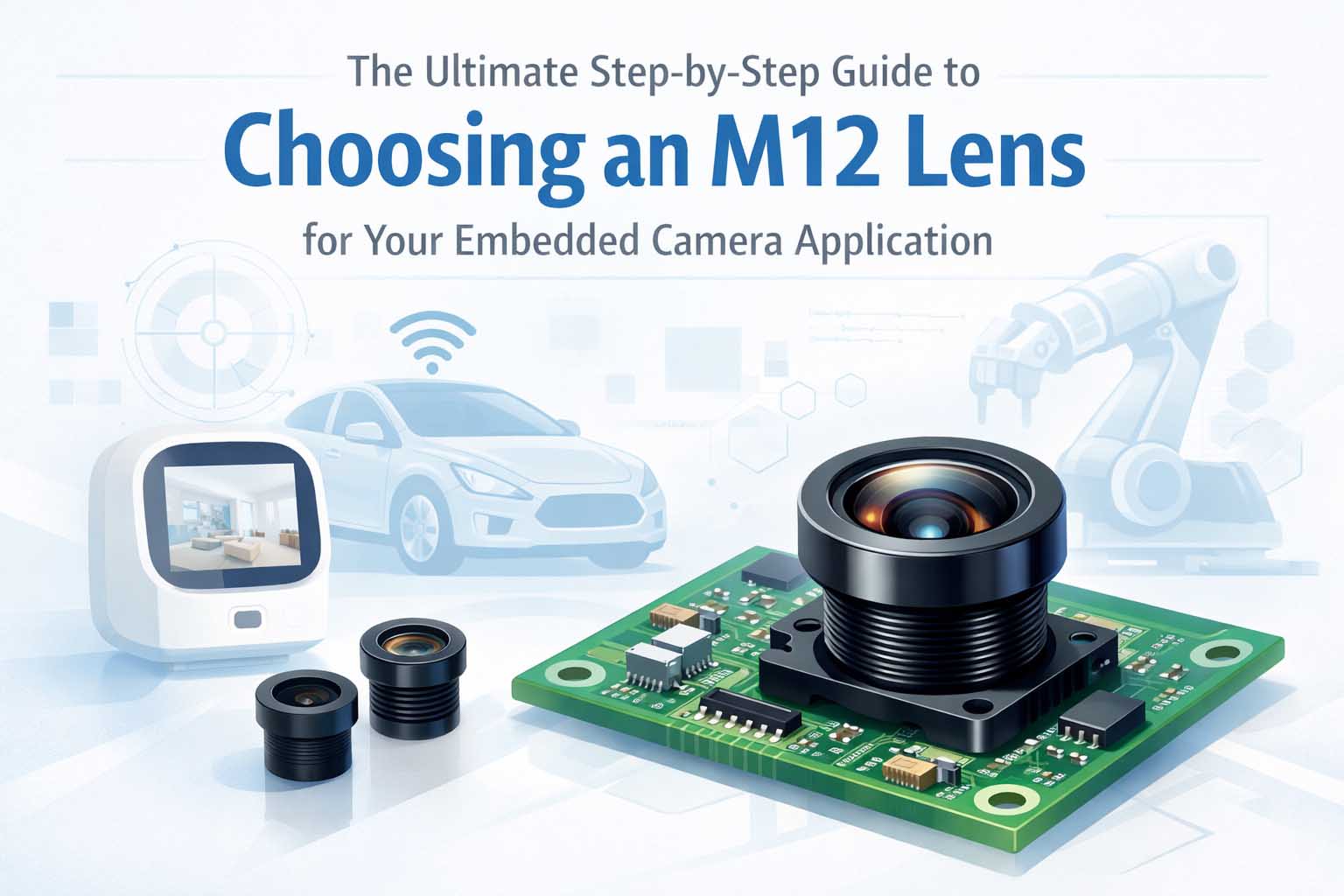
The Ultimate Step-by-Step Guide to Choosing an M12 Lens for Your Embedded Camera Application
Mar 20, 2026
Choosing the right M12 lens for embedded camera applications is critical for achieving optimal image quality, system performance, and long-term reliability. Whether you are designing a smart device, industrial vision system, or automotive solution, selecting the correct M12 lens module can significantly impact your final product.
In this guide, we’ll walk you through a step-by-step process to help you choose the best M12 camera lens for embedded systems, while covering key technical parameters and application-specific considerations.
1. Understand Your Embedded Camera Application Requirements
Before selecting an M12 lens for embedded systems, you need to clearly define your application scenario.
Common embedded applications include:
Smart home cameras
IoT devices
Industrial machine vision systems
ADAS and automotive cameras
Robotics and AI vision
Each scenario requires a different type of M12 lens for specific applications, such as:
M12 lens for surveillance camera
M12 lens for ADAS system
M12 lens for machine vision
Tip: Always start with the use case, not the lens.
2. Choose the Right Focal Length (Field of View)
The focal length determines the field of view (FOV), which is one of the most important factors when selecting an M12 wide angle lens for embedded camera.
Typical focal lengths:
1.8mm – Ultra wide-angle / fisheye
2.1mm – Wide angle
2.8mm – Standard wide-angle
3.6mm+ – Narrower field, longer distance
If your project requires a wider scene, consider:
ultra wide angle M12 lens
fisheye M12 lens for embedded systems
For more focused applications:
low distortion M12 lens for machine vision
3. Match the Sensor Size
An M12 board lens must match your image sensor size to avoid vignetting and ensure full image coverage.
Common sensor formats:
1/4"
1/3"
1/2.7"
1/2.5"
For example:
Use a M12 lens for 1/2.7 sensor camera for better compatibility
Choose a high resolution M12 lens for embedded camera module when using megapixel sensors
4. Consider Aperture and Low-Light Performance
Aperture (F-number) affects how much light enters the lens.
Key considerations:
Lower F-number (e.g., F1.8): better low-light performance
Higher F-number (e.g., F2.8): deeper depth of field
If your application includes night or indoor use:
low light M12 lens for embedded camera
night vision M12 lens module
5. Evaluate Distortion and Image Quality
Distortion is especially important in embedded vision systems such as robotics and industrial inspection.
Lens types:
Low distortion: ideal for measurement and AI vision
Wide angle: higher distortion but broader coverage
Recommended keywords:
low distortion M12 lens for industrial camera
high resolution M12 lens for machine vision
6. Check Lens Structure and Size Constraints
Embedded systems often have strict space limitations, making compact M12 lens modules essential.
Important factors:
Total Track Length (TTL)
Diameter and mounting structure
Weight and material
Best options:
compact M12 lens for embedded device
mini M12 lens module for IoT camera
7. Consider Special Features (IR, HDR, etc.)
Depending on your application, you may need specialized features:
Examples:
IR cut or IR pass for night vision
HDR compatibility
Waterproof or dustproof design
Relevant keywords:
infrared M12 lens for night vision camera
M12 lens for outdoor surveillance system
8. Choose a Reliable M12 Lens Manufacturer
Finally, selecting a trusted supplier is just as important as the technical specs.
Look for:
Customization capability
Stable quality control
Experience in embedded systems
Search-friendly keywords:
M12 lens manufacturer for embedded camera
custom M12 lens supplier for OEM projects
M12 lens factory for industrial applications
Conclusion
Selecting the right M12 lens for embedded camera applications involves balancing multiple factors, including focal length, sensor compatibility, image quality, and system constraints.
By following this step-by-step guide, you can confidently choose the best M12 lens module for your embedded system, ensuring optimal performance across a wide range of applications—from smart home devices to advanced automotive systems.




 Sign Up To Our Newsletters


 IPv6 network supported.