Understanding Underwater Lenses for Pool Cleaning Robots
Dec 06, 2025
A technical overview of imaging requirements and optical challenges in underwater environments
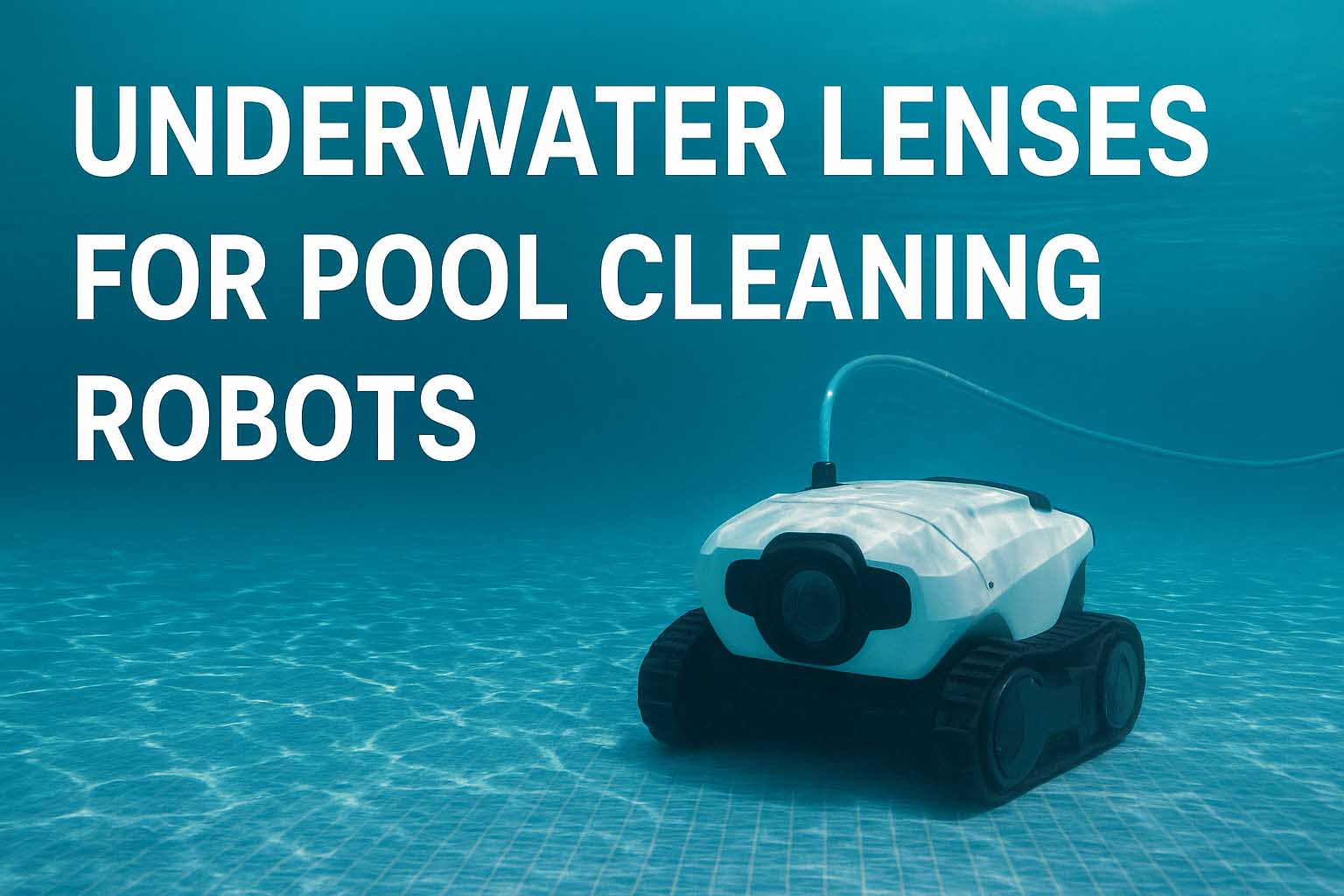
Pool cleaning robots rely on a combination of mobility, sensing, and visual perception to navigate and perform cleaning tasks. While many people associate these robots with brushes, motors, and filtration systems, the camera lens is one of the most important components enabling accurate underwater monitoring and decision-making.
1. Why Pool Robots Need an Underwater Vision System
Modern pool cleaning robots typically include at least one camera module.
The camera serves several functions:
Observing pool walls, corners, and the bottom surface
Assisting with navigation and route planning
Detecting debris, stains, or areas requiring repeated cleaning
Avoiding obstacles such as steps, drains, or pool accessories
Supporting real-time feedback or remote monitoring
A well-designed underwater lens ensures that the robot collects reliable image information even in environments with reflections, turbidity, or inconsistent lighting.
2. Optical Challenges Unique to Underwater Imaging
Unlike air, water significantly changes the behavior of light:
Refraction and Field of View Loss
Water has a higher refractive index, which reduces the effective field of view (FOV).
To compensate for this, underwater lenses often require extremely wide viewing angles.
Light Absorption and Scattering
Water absorbs light more quickly, and suspended particles scatter it.
This affects clarity, contrast, and color accuracy.
Reflection From Surfaces
Walls and the water surface can create strong highlights or glare spots.
Pressure and Exposure
Components must withstand long-term immersion, water pressure, and chemical exposure (chlorine, saltwater, cleaning agents).
These conditions make underwater optical design fundamentally different from normal surveillance or consumer cameras.
3. Key Parameters in Underwater Lens Design
(1) Focal Length (EFL)
A shorter focal length provides a wider field of view.
Underwater applications often require ultra-short focal lengths (e.g., 0.98mm–2mm) to counter refractive narrowing.
(2) Aperture (F-number)
A lower F-number (such as F1.6–F2.0) helps increase brightness in dim conditions, especially at the pool bottom or shaded areas.
(3) Field of View (FOV)
Wide-angle imaging is essential.
Typical underwater lenses for pool robots might reach:
Horizontal: 150°–180°
Vertical: 150°–180°
Diagonal: up to 200°
Such panoramic FOV allows the robot to understand its surroundings with minimal blind spots.
(4) Optical Structure (e.g., 2G3P)
Hybrid lens structures combine glass and plastic elements to balance:
Distortion correction
Weight
Thermal stability
Cost-efficiency
Glass elements improve durability and reduce optical deformation underwater.
(5) Coating and Transmittance
High transmittance (e.g., Tavg ≥ 90%) is crucial for:
Reducing light loss
Improving visibility in murky water
Maintaining color fidelity
Coatings also help resist scratches and chemical exposure.
(6) Sensor Compatibility
Underwater lenses are typically paired with sensors like Sony IMX390, which offer:
High dynamic range
Good color reproduction
Low-light sensitivity
Stability for continuous operation
(7) Waterproof and Environmental Protection
Protection levels such as IP67 or IP68 are essential to:
Prevent water ingress
Avoid fogging
Maintain clarity during long-term submersion
Operating temperature ranges like -20°C to +70°C ensure performance across seasonal changes.
4. Application Scenarios in Pool Cleaning Robots
An underwater lens contributes to multiple robotic functions:
Mapping pool geometry for navigation
Detecting fine particles or patches of dirt
Monitoring robot positioning relative to walls or slopes
Supporting AI algorithms that classify debris or surface conditions
Enhancing safety, reducing collision risks
With a wide field of view and stable underwater imaging, the robot can operate more efficiently and autonomously.
5. Future Trends in Underwater Optical Design
As pool cleaning robots become more advanced, underwater lenses will continue to evolve in the direction of:
Higher resolution for better object detection
Improved low-light imaging
More durable materials for chemical resistance
Enhanced anti-fog and anti-reflection coatings
Integration with AI-based vision systems
These improvements help robots adapt to both residential and commercial pool environments.




 Sign Up To Our Newsletters


 IPv6 network supported.