Best Lens Solutions for Surround View Systems
Jun 12, 2026
The Challenges Behind a Good Surround View System
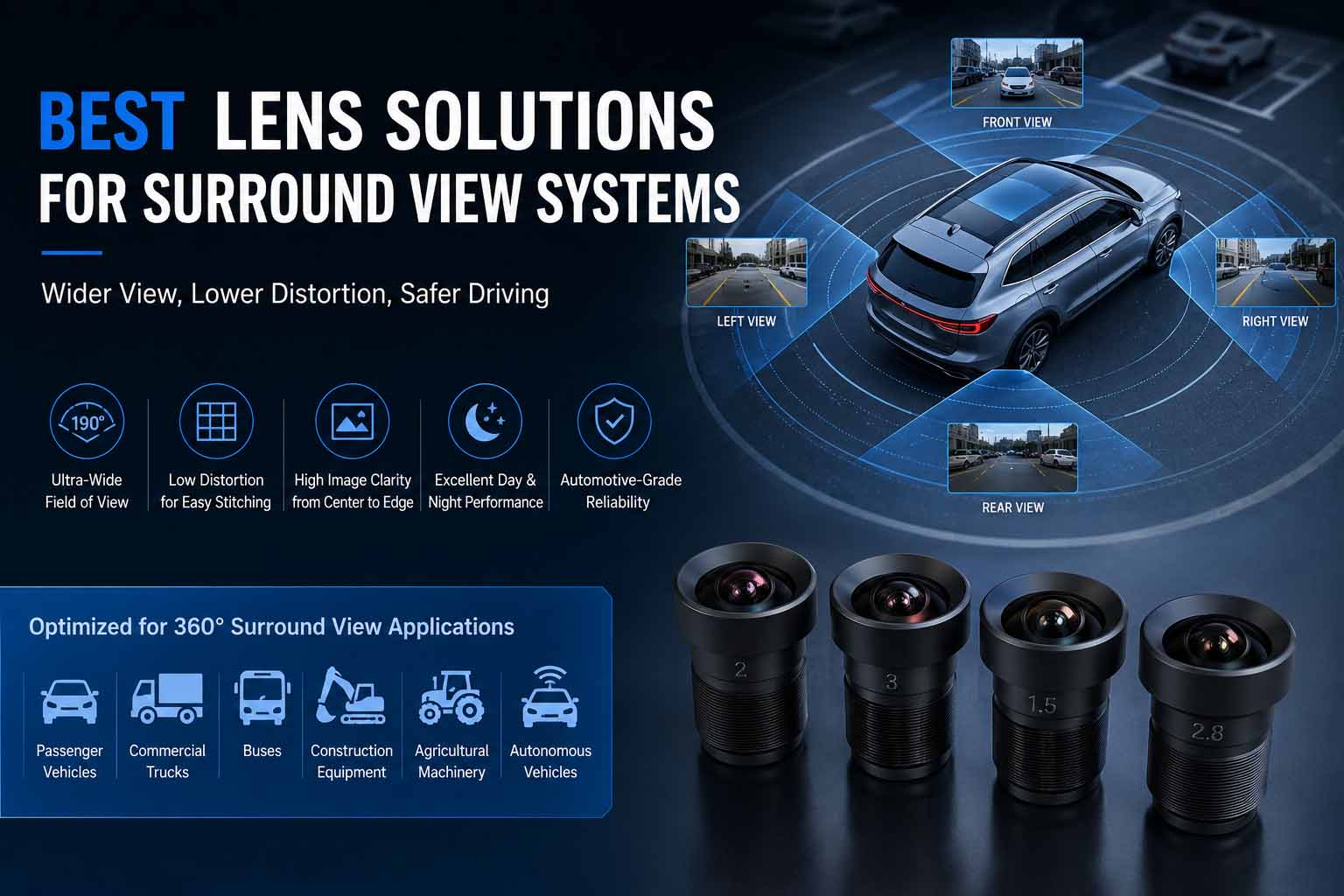
A surround view system is designed to give drivers a complete view of the area around the vehicle. By combining images from multiple cameras, the system creates a bird's-eye view that helps with parking, maneuvering, and obstacle detection.
While the final display may look simple, achieving a seamless 360-degree image is far from easy.
Many surround view projects encounter the same challenges:
Blind spots around the vehicle
Distorted stitched images
Poor edge image quality
Inconsistent brightness between cameras
Reduced visibility at night
Calibration difficulties during integration
In many cases, engineers spend significant time optimizing software algorithms, only to discover that the root cause originates from the optical system itself.
The quality of a surround view camera lens directly affects how well the entire system performs.
Why the Lens Matters More Than Most Engineers Expect
A surround view system relies on four or more cameras positioned around the vehicle.
Each camera captures a different perspective, and those images must be combined into a single overhead view.
For this process to work correctly, every camera must deliver:
Consistent image quality
Accurate geometry
Sufficient field of view
Stable brightness
Reliable day and night performance
Even small optical imperfections can create visible stitching errors.
For example:
A lens with excessive distortion may cause road markings to appear curved.
A lens with poor edge resolution may produce blurry areas near the stitching boundary.
A lens with uneven illumination may create visible brightness differences between adjacent camera views.
This is why the surround view camera lens is often one of the most critical components in an AVM system.
Ultra-Wide Field of View: The Foundation of 360-Degree Coverage
One of the primary requirements for a surround view camera is wide-area coverage.
Most AVM systems use an automotive fisheye lens with an ultra-wide viewing angle to minimize blind spots around the vehicle.
Common configurations include:
180-degree automotive lens
190-degree automotive lens
200-degree fisheye lens
A wider field of view allows each camera to cover a larger area, reducing gaps between adjacent images.
Benefits include:
Improved vehicle coverage
Reduced blind spots
Easier image stitching
Enhanced parking assistance performance
However, increasing field of view introduces additional optical challenges, particularly distortion control.
Finding the right balance between coverage and image quality is essential when selecting a lens for a 360-degree vehicle camera system.
Low Distortion Makes Image Stitching Easier
Image stitching is one of the most important functions of a surround view system.
The software must accurately merge multiple camera images into a single continuous view.
When distortion is excessive, stitching becomes more difficult and less accurate.
Typical symptoms include:
Misaligned parking lines
Broken lane markings
Warped vehicle outlines
Visible stitching boundaries
A low distortion surround view lens helps reduce these problems before software correction is applied.
Although fisheye lenses naturally introduce distortion, an optimized optical design can significantly improve image geometry and simplify system calibration.
For many automotive camera projects, distortion performance is one of the first parameters engineers evaluate during lens selection.
Image Clarity Across the Entire Frame
Many automotive camera systems achieve good sharpness in the center of the image but struggle near the edges.
This issue becomes especially noticeable in surround view applications because image stitching often occurs near the edge regions.
Poor edge performance can result in:
Blurred objects
Reduced obstacle visibility
Less accurate image stitching
Lower overall image quality
A high-quality surround view camera lens should maintain good image resolution throughout the entire field of view.
Consistent image quality improves both driver visibility and system reliability.
Night-Time Performance Is Just as Important
A surround view system must perform reliably during the day and at night.
Parking lots, underground garages, construction sites, and poorly lit roads all present challenging lighting conditions.
A lens designed for automotive applications should support:
Good light transmission
Stable image quality in low-light environments
Compatibility with HDR image sensors
Reliable infrared performance when required
Poor night-time visibility can reduce the effectiveness of parking assistance systems and increase the risk of missed obstacles.
For this reason, low-light performance is often considered alongside field of view and distortion during automotive lens selection.
Common Lens Problems Found in AVM Projects
During development, engineers frequently encounter issues that appear to be software-related but actually originate from the optical system.
Edge Blur
Objects near the edge of the image appear soft or difficult to identify.
Uneven Brightness
Different areas of the image display inconsistent illumination levels.
Calibration Difficulties
Excessive distortion increases the complexity of calibration procedures.
Inconsistent Camera Performance
Variations between lenses create visible differences between stitched images.
Reduced Visibility in Low-Light Conditions
Insufficient optical performance affects image quality at night.
Identifying and addressing these issues early can significantly reduce development time.
How to Select the Right Surround View Camera Lens
Choosing a surround view camera lens requires balancing multiple performance factors.
Field of View
A wider viewing angle provides better coverage but may increase distortion.
Distortion Control
Lower distortion simplifies calibration and improves stitching quality.
Sensor Compatibility
The lens should be optimized for the selected image sensor size and resolution.
Automotive Reliability
The lens must withstand vibration, temperature fluctuations, and long-term vehicle operation.
Image Quality Consistency
Stable optical performance is essential across all cameras in the system.
Working with an experienced automotive camera lens manufacturer can help avoid costly development delays and improve overall system performance.
Applications Beyond Passenger Cars
Although surround view systems are commonly associated with passenger vehicles, they are increasingly used across a wide range of industries.
Commercial Trucks
Large vehicles benefit from improved visibility around the entire vehicle.
Buses
Surround view cameras help reduce blind spots in urban environments.
Construction Equipment
Operators gain better awareness when working in confined spaces.
Agricultural Machinery
Enhanced visibility improves operational safety.
Mining Vehicles
Heavy equipment often operates in challenging environments where blind spot reduction is critical.
As adoption continues to grow, demand for reliable surround view camera lens solutions is increasing across multiple vehicle categories.
Why Wintop Optics for Surround View Lens Solutions
Developing a successful surround view system requires more than simply selecting a wide-angle lens.
Field of view, distortion performance, image consistency, sensor compatibility, and environmental reliability must all work together to achieve the desired result.
At Wintop Optics, we work closely with customers developing:
Surround view camera systems
Around View Monitoring (AVM) solutions
Bird's-eye view systems
Parking assistance cameras
Commercial vehicle camera systems
Special-purpose vehicle vision systems
Our engineering team focuses on solving practical imaging challenges through optimized optical design and reliable manufacturing processes.
Whether the goal is wider coverage, lower distortion, improved image quality, or easier integration, we help customers find the most suitable optical solution for their project requirements.
Talk to Our Engineering Team
If you are evaluating lens options for a new surround view project, selecting the right optical partner can significantly reduce development time and improve system performance.
Wintop Optics provides OEM and ODM automotive lens solutions tailored to the requirements of modern surround view camera systems.
Our team can assist with:
Field of view selection
Distortion optimization
Sensor matching
Mechanical integration
Prototype development
Mass production support
Visit: www.wintoplens.com
Email:yorty@yuntal.com
Tel:+86 153 0268 9906
If you are developing an AVM system, bird's-eye view camera, or 360-degree vehicle camera solution, contact Wintop Optics to discuss your project and explore the best lens solution for your application.




 Sign Up To Our Newsletters


 IPv6 network supported.