What Sensors Are Used in ADAS?
Mar 14, 2026
Advanced Driver Assistance Systems (ADAS) rely on a combination of sensors to help vehicles perceive the surrounding environment. These systems support safety features such as lane departure warning, automatic emergency braking, adaptive cruise control, and driver monitoring.
While radar, LiDAR, and ultrasonic sensors are commonly used in ADAS, camera-based perception systems remain one of the most important technologies. These cameras rely on high-performance automotive sensors combined with precisely designed M12 lenses for ADAS cameras.
Understanding which sensors are used in ADAS and how they work with automotive M12 lens solutions can help engineers design reliable vehicle vision systems.
Front ADAS Cameras and 1/2.8" Sensor M12 Lenses
Front-facing cameras are critical components in modern ADAS platforms. They are responsible for detecting lane markings, road signs, vehicles, and pedestrians.
Many front-view systems use 1/2.8-inch CMOS automotive sensors such as the Sony IMX390 HDR automotive sensor. These sensors support high dynamic range imaging, which allows the camera to handle challenging lighting conditions such as tunnels, headlights, and strong sunlight.
To match this type of sensor, manufacturers typically use 1/2.8 sensor M12 lenses for ADAS front cameras. These lenses are designed with:
optimized CRA for automotive sensors
low distortion optical design
stable imaging across temperature ranges
A well-designed automotive M12 lens for IMX390 sensors ensures clear object detection for forward collision warning and lane recognition systems.
Surround View Systems and Ultra Wide Angle M12 Lenses
Many vehicles today include a 360-degree surround view system that provides a bird’s-eye perspective around the vehicle.
These systems usually rely on multiple cameras equipped with 1/3-inch CMOS sensors for surround view cameras.
To achieve full environmental coverage, these cameras use ultra wide angle M12 lenses with 190° or greater field of view. This type of wide FOV M12 lens for surround view systems enables drivers to clearly see blind spots and nearby obstacles.
A high-quality low distortion M12 lens for 1/3 sensor automotive cameras is essential for accurate image stitching and generating a seamless panoramic view.
Driver Monitoring Sensors and Infrared M12 Lenses
Driver Monitoring Systems (DMS) use cameras inside the vehicle to track driver behavior and detect fatigue or distraction.
These cameras often use 1/3-inch near-infrared CMOS sensors, which are sensitive to 850 nm infrared illumination.
To support these sensors, manufacturers design infrared M12 lenses for driver monitoring cameras with coatings optimized for NIR wavelengths.
An IR corrected M12 lens for 1/3 sensor DMS cameras ensures clear facial detection in both daytime and nighttime driving conditions.
Side Cameras and Compact 1/4 Sensor M12 Lenses
Side-view and mirror replacement cameras are increasingly used in modern vehicles.
These compact cameras often adopt 1/4-inch automotive CMOS sensors, which allow the camera module to remain small while still providing sufficient resolution.
To match these sensors, engineers typically use compact M12 lenses for 1/4 sensor automotive cameras.
These lenses are designed with:
short optical track length
stable focus structure
wide viewing angle for side monitoring
A reliable small form factor M12 lens for automotive side cameras helps improve visibility around the vehicle and supports blind spot detection systems.
Radar and LiDAR Sensors in ADAS
Although camera systems are essential, ADAS relies on additional sensors for redundancy and improved perception.
For example:
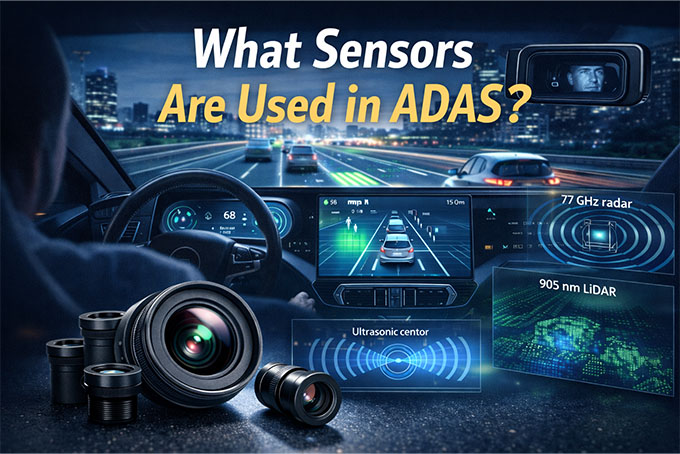
77 GHz millimeter-wave radar sensors measure object distance and speed
905 nm LiDAR sensors provide high-precision 3D mapping
40 kHz ultrasonic sensors detect nearby obstacles during parking
However, visual recognition tasks such as lane detection, traffic sign recognition, and pedestrian identification still depend heavily on high resolution M12 lenses used in automotive camera modules.
By combining radar data with camera images captured through automotive grade M12 lenses, ADAS systems can achieve higher reliability and better environmental awareness.
Why M12 Lenses Are Widely Used in Automotive Cameras
The M12 lens mount, also known as an S-mount lens, is widely used in automotive camera modules because of its compact design and flexible optical configurations.
Compared with larger lens mounts, automotive M12 lenses for ADAS cameras offer several advantages:
compact size suitable for small camera modules
cost-effective mass production
compatibility with 1/4", 1/3", and 1/2.8" sensors
availability of ultra wide angle optical designs
Modern M12 lenses for automotive vision systems can also be optimized for:
HDR sensors
low distortion imaging
wide temperature automotive environments
vibration-resistant structures
These features make M12 camera lenses a popular choice for ADAS camera manufacturers worldwide.
Conclusion
ADAS systems rely on multiple sensing technologies to ensure safe driving. Common sensors used in these systems include:
automotive CMOS camera sensors
77 GHz radar sensors
905 nm LiDAR modules
ultrasonic parking sensors
Among these technologies, camera-based perception remains essential. High-performance sensors paired with precision M12 lenses for automotive cameras enable reliable detection of lanes, vehicles, pedestrians, and road signs.
As ADAS technology continues to evolve, the combination of advanced sensors and high-quality automotive M12 lens solutions will remain a key factor in building safer and smarter vehicles.
Contact Us Today
For expert advice and reliable optical lens solutions, please contact our professional team:
Wintop Optics Team
Tel / WhatsApp / WeChat: +86 153 0268 9906 / +86 153 0268 9906
Email: yorty@yuntal.com




 Sign Up To Our Newsletters


 IPv6 network supported.