What Makes a Good Automotive Camera Lens?
May 29, 2026
Choosing an automotive camera lens is not only about finding a lens that can produce an image. For vehicle camera applications, a good lens must support stable image quality, suitable field of view, reliable structure, environmental durability, and long-term production consistency.
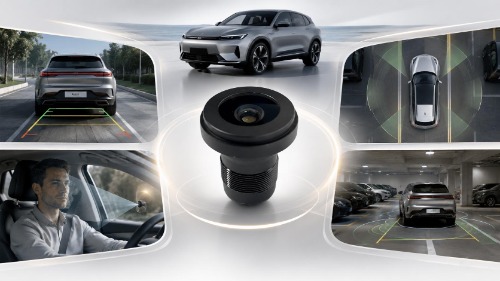
Automotive cameras are widely used in rear view systems, surround view systems, front view cameras, ADAS cameras, DMS, OMS, CMS, parking assistance, and dash camera applications. Each application has different requirements for optical performance and mechanical design.
So, what makes a good automotive camera lens? The answer depends on the camera module design, application scenario, sensor, FOV, resolution, structure, and environmental requirements.
1. A Good Automotive Camera Lens Should Match the Application
The first step in choosing an automotive camera lens is understanding the application.
A rear view camera lens, a surround view camera lens, and a driver monitoring camera lens may all be used in vehicles, but their optical requirements are not the same.
For example:
Rear view cameras usually require a wide field of view and stable outdoor performance.
Surround view cameras need ultra-wide angle coverage and good edge image quality.
Front view cameras may require clearer long-distance imaging.
DMS cameras focus more on near-distance imaging, face recognition, and IR performance.
CMS cameras require stable image quality for side and rear visibility.
Parking assistance cameras need compact structure, wide coverage, and environmental reliability.
A good automotive camera lens should be selected based on the actual application instead of using one general lens for every project.
2. Suitable Field of View Is More Important Than Simply Being Wide
Field of view is one of the most important specifications for automotive camera lenses. It determines how much area the camera can capture.
However, a wider field of view is not always better.
If the field of view is too narrow, the camera may not capture enough surrounding information. If the field of view is too wide, image distortion and edge quality may become more difficult to control.
A good automotive camera lens should provide a suitable field of view for the application while maintaining usable image clarity and distortion control.
For example:
Application
Typical FOV Consideration
Rear View Camera
Wide enough to cover the area behind the vehicle
Surround View Camera
Ultra-wide angle with good edge performance
Front View Camera
Balanced viewing angle and long-distance clarity
DMS Camera
Suitable coverage for the driver’s face and upper body
OMS Camera
Wider cabin coverage
CMS Camera
Stable side and rear viewing area
The right FOV should be decided according to the vehicle camera system design, not only by lens appearance or general specifications.
3. Low Distortion Helps Keep the Image More Usable
Many automotive camera lenses require wide-angle design. However, wide-angle lenses often bring distortion, especially near the edge of the image.
In vehicle camera applications, excessive distortion may affect the visual experience and reduce the usability of the image. For example, parking reference lines, surrounding objects, road edges, and vehicle surroundings may appear less accurate if distortion is not well controlled.
For surround view systems, low distortion and stable edge imaging are especially important because images from multiple cameras may need to be processed or stitched together.
A good automotive camera lens should balance wide viewing angle and distortion control. It should help maintain a more natural and usable image structure for the camera module.
4. The Lens Should Match the Sensor, Not Limit It
Many camera module projects use 2MP, 5MP, 8MP, or higher-resolution sensors. But a high-resolution sensor does not automatically guarantee a high-quality image.
If the lens cannot match the sensor’s optical requirements, the final image quality may still be limited.
When evaluating an automotive camera lens, customers should consider:
Sensor size
Image circle
Resolution matching
Chief ray angle
FOV requirement
Edge image quality
Mechanical structure
Working distance
A good automotive camera lens should allow the sensor to perform properly. The lens and sensor need to work together as part of the complete camera module system.
5. Stable Image Quality Across the Whole Image Field
Some lenses may show good image quality in the center but weaker performance near the edge. For automotive applications, this can be a problem.
In rear view, surround view, CMS, and parking assistance applications, the edge area of the image may contain important visual information. If the edge image is blurry or distorted, it may affect the overall camera performance.
A good automotive camera lens should provide stable image quality across the image field, not only in the center.
This is especially important for wide-angle automotive camera lenses, where edge clarity, distortion control, and image consistency all need to be considered.
6. Automotive Camera Lenses Need Environmental Reliability
Automotive environments are more demanding than many consumer electronics applications. A lens used in a vehicle may need to face temperature changes, vibration, humidity, dust, water exposure, and long-term operation.
Exterior camera applications such as rear view cameras, surround view cameras, side view cameras, and parking cameras may require waterproof and dustproof performance. Interior applications such as DMS and OMS may pay more attention to IR performance, low-light imaging, and stable near-distance image quality.
Depending on the project, automotive lens requirements may include:
Waterproof design
Dust resistance
Temperature resistance
Vibration resistance
Stable optical performance
Reliable mechanical structure
Long-term production consistency
A good automotive camera lens should be designed and evaluated according to the real working environment of the vehicle camera system.
7. Mechanical Structure Must Fit the Camera Module
An automotive camera lens is not only an optical component. It must also match the camera module structure.
Different projects may require different lens structures, such as M7, M8, M9, M10, M12, AA structure, or customized mechanical designs.
The suitable structure depends on:
Module size
Sensor position
Optical path
Assembly method
Waterproof design
Space limitation
Application environment
Mass production process
For camera module manufacturers, choosing a lens with the right mechanical structure can help improve assembly efficiency and project feasibility.
A good automotive camera lens should match both the optical requirements and the mechanical design of the camera module.
8. Production Consistency Matters for Automotive Projects
For automotive camera projects, a good sample is only the beginning. Customers also care about whether the lens can maintain stable quality during mass production.
Automotive projects usually require long-term cooperation, stable supply, quality control, and consistent optical performance across batches.
Important factors include:
Sample consistency
Batch stability
Assembly accuracy
Quality inspection
Production control
Long-term supply capability
Communication efficiency during project development
A good automotive camera lens supplier should support not only lens selection and sample evaluation, but also stable mass production and quality management.
9. Supplier Capability Is Part of Lens Quality
When customers evaluate an automotive camera lens, they are also evaluating the supplier behind the lens.
For automotive projects, supplier capability can directly affect project efficiency, product reliability, and long-term cooperation.
A reliable automotive lens supplier should have:
Automotive lens project experience
Quality control system
Optical design and evaluation support
Ability to support different lens structures
Stable production capability
Clear project communication
Experience with camera module requirements
Wintop Optics has TS16949 and ISO certifications, as well as experience in automotive lens projects. These capabilities help support quality control, production consistency, and project-based lens evaluation for automotive camera module customers.
10. Wintop Optics Automotive Camera Lens Solutions
Wintop Optics provides automotive camera lens solutions for different vehicle camera applications, including rear view cameras, surround view cameras, front view cameras, CMS, DMS, OMS, ADAS cameras, parking assistance cameras, and other camera module projects.
We support different lens structure options, including M7, M8, M9, M10, M12, and AA lens solutions. According to the customer’s project requirements, we can help evaluate sensor matching, FOV, resolution, structure, application environment, and optical performance needs.
If you are looking for an automotive camera lens solution, please send us your project information, including sensor model, sensor size, FOV, resolution, structure type, working distance, and application scenario. Our team can help recommend a suitable lens solution for your camera module project.
Tel / WhatsApp: +86 15302689906Email: yorty@yuntal.com
FAQ
How do I choose the right automotive camera lens?
To choose the right automotive camera lens, you need to consider the application, sensor model, sensor size, FOV, resolution, working distance, structure type, and operating environment. Different automotive camera applications require different lens designs, so lens selection should be based on the actual camera module project.
Is a wider FOV always better for vehicle camera applications?
No. A wider FOV can capture more surrounding information, but it may also bring more distortion and edge image challenges. The best FOV should meet the application requirement while maintaining usable image quality, distortion control, and sensor matching.
Why is low distortion important for automotive camera lenses?
Low distortion helps keep the image structure more natural and usable. This is important for applications such as rear view cameras, surround view systems, parking assistance, and image recognition. For wide-angle automotive lenses, distortion control should be considered together with FOV and edge clarity.
Can one lens fit different sensors?
Not always. Lens and sensor matching depends on sensor size, image circle, resolution, CRA, FOV, and mechanical structure. Even if two sensors have similar resolution, they may require different lens designs. Providing the sensor datasheet can help engineers evaluate whether a lens is suitable.
What lens structure should I choose: M7, M8, M9, M10, M12, or AA?
The suitable lens structure depends on the camera module size, assembly method, optical requirements, and application environment. M7, M8, M9, M10, M12, and AA structures can be considered according to project needs. For compact modules, smaller structures may be required. For higher alignment or specific assembly needs, AA structure may be evaluated.
Do automotive camera lenses need waterproof design?
It depends on the application. Exterior automotive cameras, such as rear view cameras, surround view cameras, side view cameras, and parking cameras, often need waterproof and dustproof considerations. Interior cameras, such as DMS and OMS, may focus more on IR, low-light imaging, and near-distance performance.
Can Wintop customize lenses according to our camera module requirements?
Yes. Wintop Optics can help evaluate lens solutions according to your sensor model, FOV, resolution, structure, working distance, and application requirements. We support different automotive camera lens structures, including M7, M8, M9, M10, M12, and AA solutions.
Looking for a Suitable Automotive Camera Lens?
Every automotive camera project has different optical and structural requirements. Whether your application is rear view, surround view, front view, CMS, DMS, OMS, ADAS, or parking assistance, lens selection should be based on the actual camera module design.
Wintop Optics supports automotive camera lens solutions with different structures and project-based evaluation.
Share your sensor model, FOV, resolution, structure, working distance, and application requirements with us. Our team will help recommend a suitable lens solution for your project.
Tel / WhatsApp: +86 15302689906Email: yorty@yuntal.com




 Sign Up To Our Newsletters


 IPv6 network supported.