How Lenses Impact AI Traffic Monitoring Systems Accuracy
Apr 30, 2026
1.The Optical Foundation Behind AI Traffic Monitoring
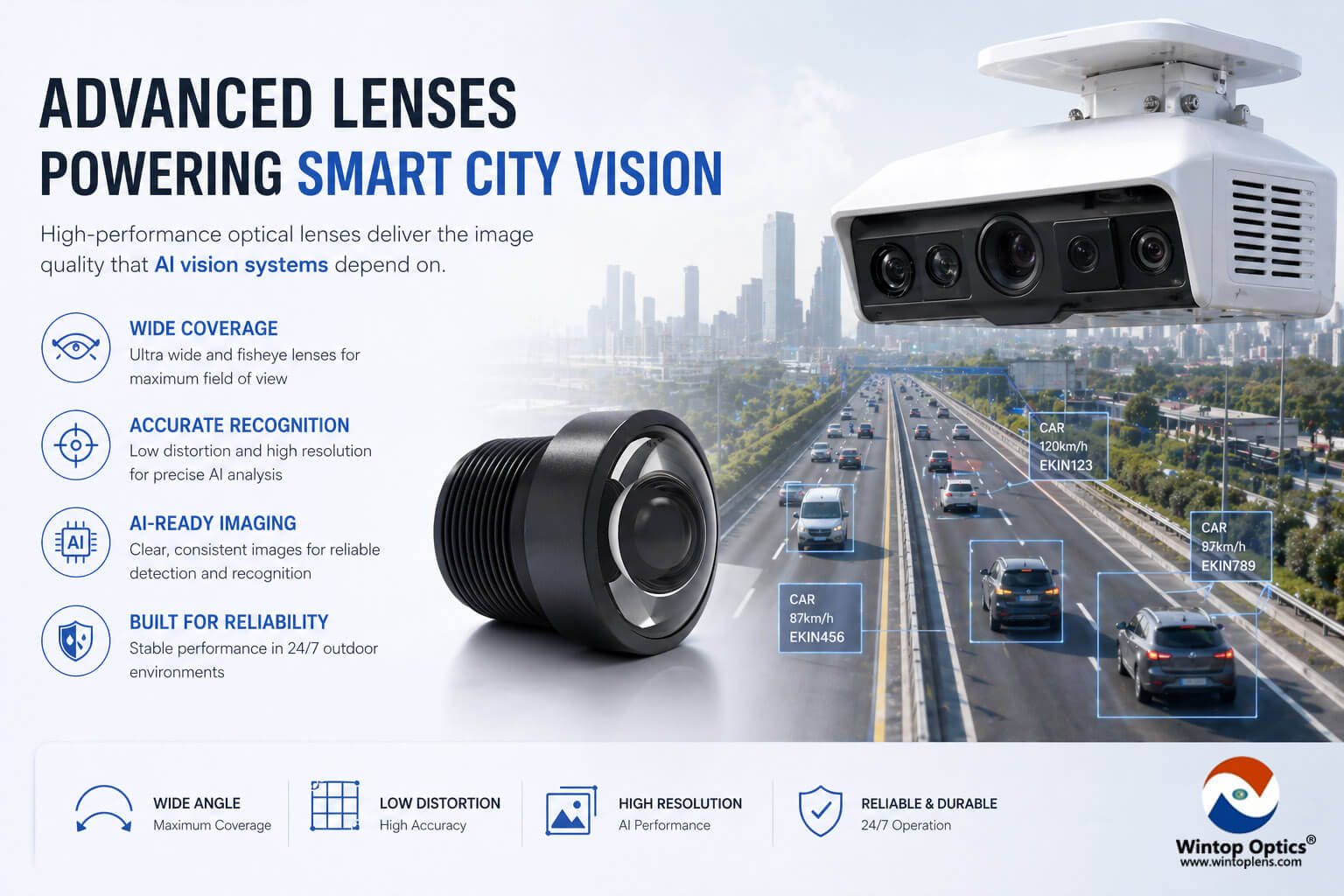
Modern AI traffic monitoring systems are designed to do far more than record footage; they interpret complex road scenarios in real time, from vehicle detection to behavioral analysis. At the core of this capability lies the camera lens for traffic monitoring, which directly determines how much visual information can be captured and how accurately it can be processed. A well-designed machine vision lens for traffic systems ensures that the data fed into AI algorithms is clear, undistorted, and consistent, ultimately improving overall system performance. Without high-quality optics, even the most advanced AI models may struggle with unreliable inputs, leading to reduced detection accuracy and inconsistent results.
2.Why Image Quality Determines AI Recognition Accuracy
In applications such as license plate recognition (ALPR) and multi-lane traffic monitoring, image quality is the deciding factor between successful identification and missed data. A high resolution lens for license plate recognition enables systems to capture fine details at speed and distance, while a low distortion lens for traffic monitoring preserves the geometric integrity of vehicles and road markings. This becomes especially critical when AI models rely on pixel-level precision to interpret patterns. Poor optical performance can introduce noise, blur, or distortion, all of which negatively affect AI detection accuracy and compromise real-time traffic analysis. Therefore, the relationship between image quality for AI vision systems and lens design cannot be overlooked.
3.Field of View, Coverage, and Blind Spot Reduction
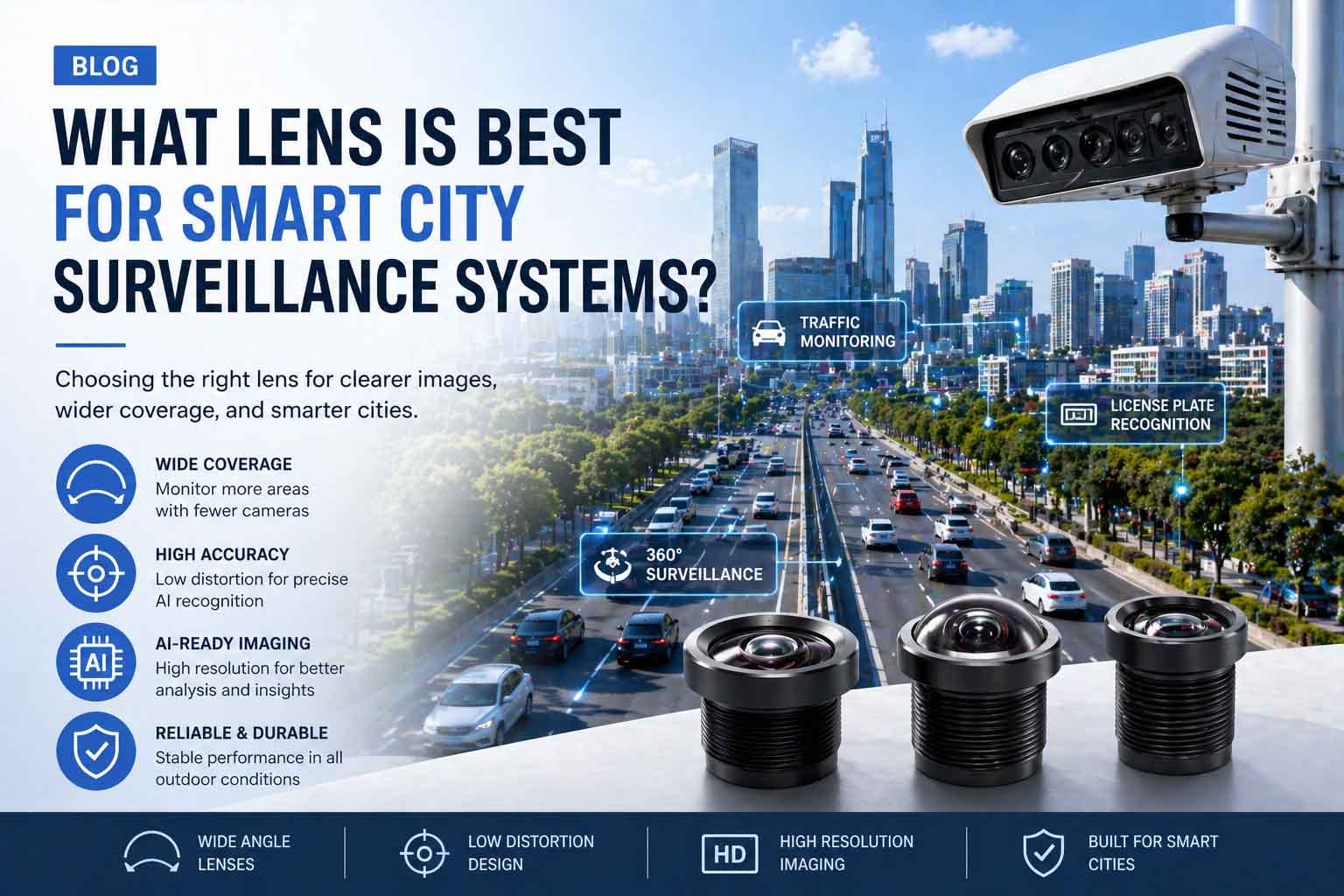
One of the key challenges in traffic surveillance systems is achieving wide coverage without sacrificing accuracy. A wide angle lens for traffic surveillance or even a fisheye lens for 360 degree traffic monitoring can significantly expand the observable area, enabling fewer cameras to monitor more lanes or intersections. This is particularly valuable in smart city traffic monitoring, where reducing infrastructure complexity is a priority. However, increasing the field of view often introduces distortion, which must be carefully controlled to maintain reliable analytics. A properly engineered panoramic traffic monitoring lens can balance wide coverage with optical precision, helping systems reduce blind spots while still supporting accurate AI-based decision-making.
4.Adapting to Real-World Traffic Environments
Unlike controlled environments, outdoor traffic monitoring systems must operate under constantly changing conditions, including lighting variations, weather exposure, and high-speed motion. In such scenarios, the choice of an industrial grade optical lens becomes essential. A robust camera lens for traffic monitoring designed for 24/7 operation ensures consistent imaging performance in harsh environments, which is critical for applications such as highway monitoring and urban surveillance. Additionally, lenses optimized for long distance monitoring allow systems to maintain clarity across multiple lanes, supporting accurate tracking and identification even in complex traffic flows.
5.Choosing the Right Lens for High-Accuracy Traffic Systems
Selecting the ideal AI traffic monitoring camera lens requires a careful balance of focal length, distortion control, resolution, and environmental durability. For example, a low distortion lens for machine vision helps maintain positional accuracy, while a wide field of view lens for surveillance ensures comprehensive coverage. At the same time, compatibility with sensors and system integration requirements must be considered, particularly in embedded or compact camera designs. Ultimately, the right lens is not defined by a single parameter, but by how well it supports the overall goal of improving AI-based traffic analysis accuracy.
6.Enhancing Smart Traffic Systems with Wintop Optics
At Wintop Optics, we understand that high-performance optics are the foundation of reliable intelligent transportation systems. Our portfolio includes wide angle lenses, fisheye lenses, and custom M12 lens solutions specifically designed for AI traffic monitoring and smart city applications. By combining low distortion optical design, high-resolution imaging, and stable performance in outdoor environments, our lenses help improve detection accuracy and system efficiency. Beyond product performance, we offer flexible OEM/ODM support, fast response times, and tailored optical solutions to meet diverse project requirements. If you are looking for a trusted partner in custom traffic monitoring lens manufacturing, Wintop Optics is ready to support your next-generation vision system.
Looking for a reliable optical lens manufacturer for your smart city or AI vision project?
📞 +86 15302689906
📧 yorty@yuntal.com
Let’s discuss how our lenses can support your next-generation vision system.




 Sign Up To Our Newsletters


 IPv6 network supported.