What Are You Looking For?

How ADAS Camera Lenses Improve Vehicle Safety and Autonomous Driving Performance
Jun 05, 2026The automotive industry is undergoing a major transformation. Vehicles are no longer simple transportation tools—they are becoming intelligent systems capable of perceiving, analyzing, and responding to their surroundings.
At the center of this evolution is Advanced Driver Assistance Systems (ADAS), a collection of technologies designed to improve driving safety, reduce accidents, and support the transition toward autonomous driving.
While much attention is given to artificial intelligence, sensors, and software algorithms, one critical component often receives less recognition: the ADAS camera lens.
Every lane marking detected, every traffic sign recognized, and every pedestrian identified begins with the quality of the image captured by the lens.
A high-performance automotive camera lens serves as the vehicle's visual gateway, ensuring that ADAS systems receive accurate and reliable information in real-world driving conditions.
In this article, we explore the role of ADAS camera lenses, their key applications, performance requirements, selection criteria, and future development trends.
An ADAS camera lens is a specialized optical lens used in vehicle camera systems that support Advanced Driver Assistance Systems.
Unlike consumer camera lenses, automotive lenses must operate reliably in highly demanding environments while maintaining exceptional image quality.
These lenses work with image sensors, processors, and AI algorithms to capture visual information and convert it into actionable data.
Common applications include:
Forward-facing cameras
Surround-view cameras
Rear-view cameras
Electronic mirror systems (CMS)
Driver Monitoring Systems (DMS)
Occupant Monitoring Systems (OMS)
Autonomous driving perception cameras
Because ADAS systems directly influence driving decisions, the reliability of the optical lens is crucial.
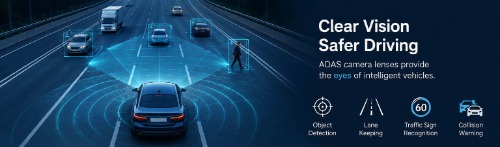
The performance of an ADAS system is only as good as the data it receives.
If the lens captures distorted, blurry, or incomplete images, even the most advanced AI algorithm may struggle to identify hazards correctly.
An automotive optical lens directly impacts:
Vehicles must identify:
Cars
Trucks
Motorcycles
Cyclists
Pedestrians
Road barriers
Clear imaging improves recognition rates and reduces false detections.
Lane Keeping Assist (LKA) relies on highly accurate lane identification.
Low-distortion optics help preserve the geometry of lane markings, improving system reliability.
Traffic signs are often small, distant, and affected by lighting conditions.
High-resolution automotive camera lenses enable better recognition performance.
ADAS systems often have milliseconds to react.
A clear image helps accelerate image processing and improves decision-making efficiency.
According to industry forecasts, the global ADAS market is expected to continue growing rapidly as governments and manufacturers prioritize vehicle safety.
Many modern vehicles now include:
Automatic Emergency Braking (AEB)
Lane Departure Warning (LDW)
Lane Keeping Assist (LKA)
Adaptive Cruise Control (ACC)
Traffic Sign Recognition (TSR)
Each of these systems depends heavily on camera-based vision.
As a result, demand for professional automotive camera lenses continues to increase.
Automotive manufacturers and Tier-1 suppliers are actively seeking reliable ADAS lens manufacturers capable of providing stable quality and scalable production capacity.
The front camera is often considered the primary visual sensor of an ADAS system.
It monitors the road ahead and supports:
Lane detection
Vehicle detection
Traffic sign recognition
Pedestrian detection
A forward-facing ADAS camera lens typically requires:
High resolution
Low distortion
Long-term stability
Wide dynamic range compatibility
360-degree camera systems help drivers park and maneuver safely.
These systems require ultra-wide-angle automotive camera lenses capable of capturing comprehensive vehicle surroundings.
Many modern vehicles are replacing traditional mirrors with camera systems.
CMS lenses must provide excellent image quality while minimizing distortion.
DMS cameras track driver attention and fatigue.
These systems often require infrared-compatible automotive lenses for reliable operation under varying lighting conditions.
Higher-level autonomous vehicles rely on multiple cameras working together.
In these systems, optical performance becomes even more critical.
Modern sensors continue to increase in resolution.
A professional automotive camera lens should support:
2MP
4MP
8MP
Higher-resolution sensors
without sacrificing image quality.
Distortion can negatively affect:
Distance estimation
Lane recognition
Object tracking
Low-distortion optics ensure accurate scene representation.
Vehicles experience extreme environmental conditions.
Automotive lenses must typically operate between:
-40°C to +85°C
while maintaining optical stability.
Continuous vehicle vibration can impact optical alignment.
Automotive-grade lens structures are engineered to maintain performance under harsh conditions.
Dust, water, mud, and road debris can challenge camera systems.
IP69-rated designs help ensure long-term reliability.
Many ADAS and monitoring systems operate in low-light conditions.
IR-compatible lenses improve night-time performance and image consistency.
Designing an automotive lens is significantly more demanding than developing a consumer electronics lens.
Failures can directly affect vehicle safety.
Automotive products often require compliance with stringent industry standards.
Automotive programs may remain active for many years.
Manufacturers must ensure supply stability and product consistency.
A lens that performs well in a prototype is not enough.
Consistency across thousands or millions of units is essential.
When selecting an ADAS lens supplier, engineers and purchasing teams should evaluate several factors.
The lens must match the image sensor size and resolution.
Different applications require different viewing angles.
For example:
Front cameras: medium FOV
Surround-view systems: ultra-wide FOV
DMS cameras: optimized cabin FOV
Important metrics include:
MTF performance
Distortion control
Relative illumination
Chief ray angle (CRA)
Automotive applications demand exceptional durability.
Choose an automotive lens manufacturer with proven production capabilities and quality control systems.
The next generation of automotive vision systems will require even more advanced optical solutions.
Future developments include:
8MP and above will become increasingly common.
Lens structures will be optimized specifically for machine vision algorithms.
Low-light performance will remain a key development area.
Higher levels of autonomy will require greater optical precision.
Future vehicles may utilize more than ten cameras simultaneously.
This trend will drive further innovation in automotive optical lens technology.
Selecting the right partner is just as important as selecting the right lens.
At Wintop Optics, we specialize in designing and manufacturing high-performance optical lenses for automotive and intelligent vision applications.
Our capabilities include:
Experienced engineering teams support customized lens development for ADAS and automotive camera projects.
We understand the strict reliability and quality requirements of automotive applications.
Customized optical solutions are available to meet specific project requirements.
Each production stage is carefully monitored to ensure consistency and performance.
Our manufacturing facilities support both prototype development and large-scale production programs.
With extensive experience in automotive optical systems, Wintop Optics helps customers develop reliable vision solutions for next-generation vehicles.
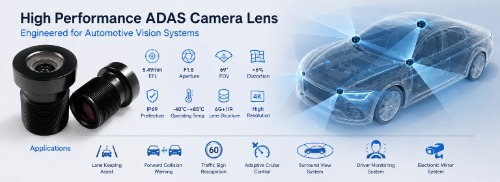
ADAS lenses are designed for automotive environments and must meet stricter requirements for temperature resistance, vibration resistance, durability, and reliability.
The optimal field of view depends on the application. Forward-facing ADAS cameras commonly use moderate viewing angles that balance detection distance and coverage.
Low distortion improves object recognition, lane detection accuracy, and distance estimation.
Yes. High-performance automotive camera lenses are essential components of autonomous driving perception systems.
As ADAS technologies continue to reshape the automotive industry, the importance of high-quality camera lenses cannot be overstated.
From lane keeping and collision avoidance to autonomous driving and intelligent monitoring, every visual decision begins with optical performance.
Choosing the right ADAS camera lens and partnering with an experienced automotive lens manufacturer can significantly improve system reliability, safety, and long-term performance.
Whether you are developing forward-facing cameras, surround-view systems, CMS solutions, or autonomous driving platforms, investing in high-quality automotive optics is essential for success.
Looking for a reliable ADAS Camera Lens Manufacturer, Automotive Camera Lens Supplier, or custom optical solution for your automotive project?
Wintop Optics
Website: www.wintoplens.com
TEL/WhatsApp:+86 153 0268 9906
Email:yorty@yuntal.com
We welcome inquiries from automotive OEMs, Tier-1 suppliers, camera module manufacturers, and intelligent mobility solution providers worldwide.
Contact our team today to discuss your next automotive vision project.
 Sign Up To Our Newsletters
Tel : Overseas contact Lina : 86 153-0268-9906
Overseas emial : yorty@yuntal.com
WhatsApp : +86 153-0268-9906
E1108, Jinbolong Building, Longhua, Shenzhen,Guangdong, China


Friendly Links :
whatsappCopyright © 2026 WINTOP OPTICS. All Rights Reserved.粤ICP备2025439823号-1
 IPv6 network supported.